
Spreading the dough, scooping sauce, placing it in the oven, taking it out when baked, boxing and slicing... At the 2026 World Robot Conference exhibition area, a wheeled dual-arm humanoid robot that can bake pizza attracted visitors to stop and watch.
The 2026 World Robot Conference was held in Beijing from August 19 to 23, under the theme "Human-Robot Symbiosis, Production-Demand Integration," attracting more than 300 well-known domestic and international enterprises and over 3,000 innovative products. China continues to tackle scientific and technological challenges, promote international scientific and technological innovation cooperation, and accelerate the process of technological R&D and industrialization, enabling China's robot industry to move from technological breakthroughs to scenario integration, and accelerating the global reach of related technologies and products.
"This is our company's third time participating in the World Robot Conference. Compared with previous static robots that completed single commands, the robots we are exhibiting this time are 'smarter' and can complete more complex and more refined tasks," said Lu Xizhe, public relations director of Urich Robotics (Suzhou) Co., Ltd. "In addition to domestic customers, our robots for scenarios such as scientific research, warehousing, and security have also been delivered to customers in Russia, the United States, India, Singapore, and other countries. In the future, the company will continue to expand the boundaries of robot capabilities and promote large-scale application."
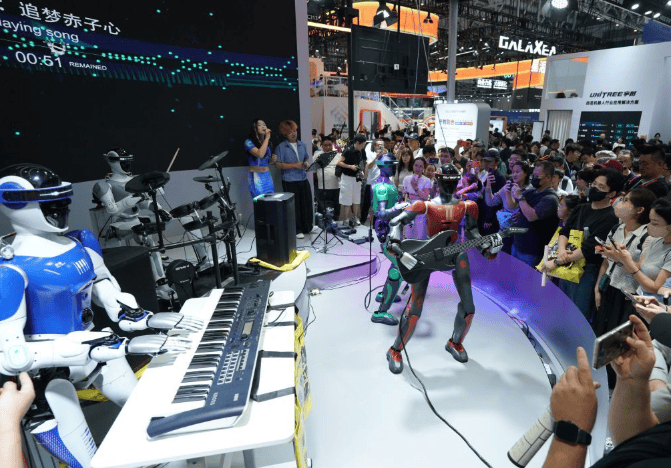
Besides baking pizza, the robots at the Urich booth can also brew tea, paint ink wash paintings, make beds, or transform into a band of keyboardist, drummer, and guitarist, performing melodious tunes such as "Beijing Welcomes You."
At another booth in the 2026 World Robot Conference exhibition area, robots used in scenarios such as industrial production lines and retail stores each performed their own duties in an orderly manner.
Dismantling a pile of boxes from one location, then transporting them to another for palletizing, Beijing Galbot Co., Ltd.'s heavy-load robot Galbot S1 demonstrated its ability to continuously perceive surrounding changes and adjust actions in real time based on material status.
According to reports, Galbot S1 has achieved 7×24-hour normal operation on CATL's production lines, meeting the requirements for efficiency, precision, and stability. At the same time, Galbot has also established cooperation with industrial partners such as SAIC, BAIC, Bosch, and Hyundai to further integrate embodied intelligence into the manufacturing system.
Xu Xiaolan, chairman of the Chinese Institute of Electronics, said that in recent years, China's robot industry has achieved a huge leap from "small to large" and from "weak to strong," becoming the world's largest industrial robot market for many consecutive years, with the overall level of the humanoid robot industry leading globally.
A Korean company named Dynamic Solution attended the conference for the first time. According to reports, the company focuses on brain-computer interfaces and wearable robots, with products previously sold mainly to European and American markets. With the rapid expansion of China's robot market consumption and the technological improvement of Chinese companies in the brain-computer interface field, the company hopes to strengthen cooperation with Chinese companies in the future and explore the vast Chinese market.
Data from China's Ministry of Industry and Information Technology shows that in 2025, the operating revenue of enterprises above designated size in the robot industry exceeded 300 billion yuan, with an average annual growth rate of over 20% in the past five years; in the first half of this year, operating revenue reached 165.5 billion yuan, a year-on-year increase of 24.5%.
SMC (China) Co., Ltd., a Japanese-invested enterprise, is a manufacturer of pneumatic components. In recent years, it has cooperated with some Chinese robot companies, bringing breakthrough changes and diversified functions to the highly automated and flexible industrial robots, making robots work more efficiently. Staff member Zhang Shiji said the company has participated in the World Robot Conference multiple times and will continue to deepen its presence in the Chinese market and further promote industrial intelligence.
During the conference, the "Global Robot Application Exploration Plan" was released. The plan will solicit application scenario needs from around the world, selecting 1,000 application scenarios each year for free trials and secondary development of robots, aiming to achieve two-way empowerment of technology implementation and scenario application, and build an open and win-win global robot industry innovation ecosystem.
Liu Yulong, co-founder of Zhishen Technology, said that in the first half of this year, the company mass-produced and delivered over 10,000 embodied intelligent robots. Currently, the company's robots are mainly used in fields such as emergency firefighting, industrial inspection, security patrol, and science, education, culture, and entertainment. "We hope to work together with upstream and downstream partners in the industry chain to promote the development of the embodied intelligence industry and bring embodied intelligence technology to the benefit of the public."