
The "Chengan No.1," an operation-grade offshore intelligent unmanned surface vehicle integrating "stabilization-navigation-survey-operation" capabilities, was officially put into operation recently in the waters around Chenghai 1-1 artificial island in Bohai Bay, completing its first round of offshore tests under sea state 3 conditions.
The "Chengan No.1" was independently developed under the leadership of PetroChina Dagang Oilfield Company, in collaboration with CNPC Engineering Technology Research Company Limited and Hohai University, marking a new stage of intelligent unmanned operations in offshore oil and gas facility inspection in China.
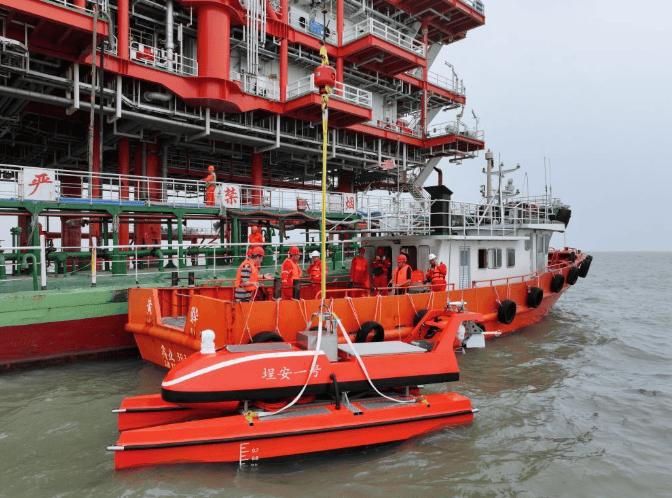
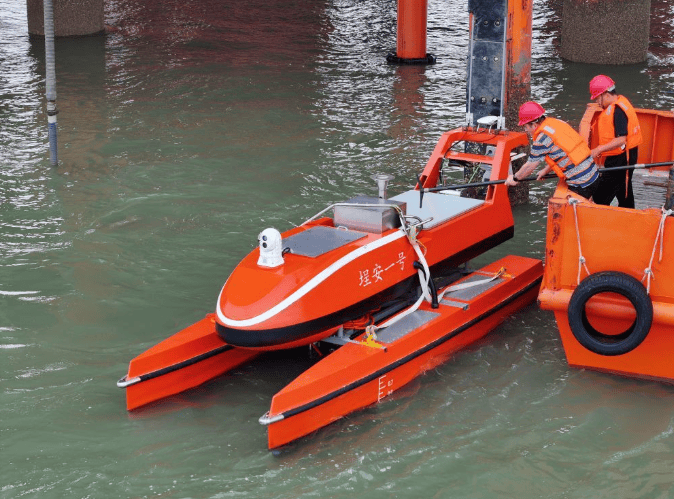
In the shallow waters of Bohai Bay, where wind, waves, and currents intertwine, and subsea oil and gas pipelines and cables are densely distributed, traditional manned inspection faces challenges such as limited operational windows, high personnel risks, and considerable costs. The "Chengan No.1" adopts a twin-hull suspended vibration-damping upper deck stable configuration, with a designed endurance of no less than 12 hours, enabling stable autonomous navigation, equipment deployment, and pipeline survey missions under sea state 3 conditions. Leveraging environmental perception, autonomous obstacle avoidance, and flow-adaptive path planning technologies, the unmanned vessel can automatically plan routes, significantly improving navigation and survey line accuracy under complex sea conditions.
In terms of survey operations, the "Chengan No.1" can be equipped with multibeam echo sounders, side-scan sonar, sub-bottom profilers, magnetometers, and other devices to collaboratively conduct subsea terrain mapping and pipeline positioning. It is also fitted with payload lifting, towing, and launch-and-recovery mechanisms, enabling autonomous deployment and recovery of survey equipment, achieving an upgrade from a "payload-carrying platform" to a comprehensive underwater operation platform.
Project lead Bian Feng stated: "Previously, inspection vessels would not dare to venture out easily under such sea conditions. Now, operators can simply click a mouse in the office to have the unmanned vessel carry out precise operations amid wind and waves."
Currently, the "Chengan No.1," leveraging its modular interfaces, can be rapidly expanded to scenarios such as offshore wind farm surveys, underwater target search, and hydrological monitoring, establishing an intelligent operation model of "remote planning onshore, unmanned execution at sea, real-time data transmission, and autonomous vessel return," providing solutions for the safe inspection of offshore energy facilities.