
According to information obtained by Dimension Network from IBM's official website, the company has connected two quantum modular cryostats and cooled them to the same ultra-cold environment. This marks a key engineering validation on IBM's quantum roadmap, suggesting that in the future, hundreds of quantum chips could be coupled through a modular cryogenic system to form a more powerful fault-tolerant quantum computer.
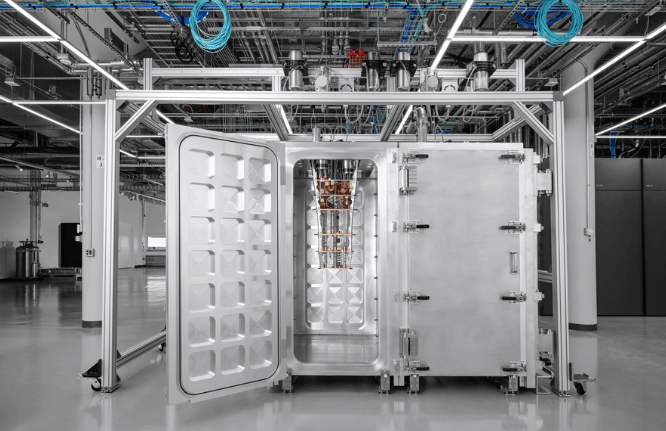
The design goal of this cryogenic architecture is to integrate three pathways—modularity, shared infrastructure, and ultra-cold environments—to enable hundreds of quantum chips to interconnect and tackle larger-scale problems. IBM stated that the completion of the new system is a milestone on the path to its "IBM Quantum Starling" initiative (hereinafter referred to as "Starling"). The initiative aims to deliver a large-scale fault-tolerant quantum computer by 2029, integrating advances in error correction codes, processor design, decoding, and systems engineering. It is expected to become the world's first fault-tolerant quantum computer.
With the first two cryostats now operational, the combined unit exceeds 8 feet in both height and width. Initial tests show that the entire system can be jointly cooled from room temperature to 4 kelvin—the temperature of liquid helium—in less than 5 days; subsequently, the final temperature is further reduced to below 15 millikelvin. This temperature is more than 180 times colder than deep space, providing the thermal environment required for the stable operation of superconducting qubits.
Inside the vacuum shell of each cryostat, the wiring space has been increased by up to 12 times compared to IBM's most widely deployed quantum systems, allowing for more ample chip interconnections both within and between cryostats. The new design adopts a box-shaped form factor, enabling multiple modules to be placed closely side by side, using the expanded space to directly connect quantum processors via IBM's proprietary L-couplers. The L-coupler's role is to link different quantum chips together, allowing them to share information, communicate with one another, and work collaboratively as part of a larger quantum computer.
According to IBM's quantum roadmap, by 2027, they will use L-couplers to connect multiple processors into a larger quantum computer with at least 1,000 programmable qubits, which can be directly used to perform computations. By the time "Starling" is delivered, IBM plans for each cryostat to house thousands of qubits.
When IBM introduced "Starling" last year, it also released a new error correction code that significantly reduces the physical resource overhead required to achieve fault tolerance. Since then, the company has achieved successive breakthroughs in demonstrations of core hardware components and efficient error-correcting decoding. The latest achievement in cryogenic quantum modules has now resolved another major engineering obstacle on the path to accelerating fault-tolerant quantum computing.
IBM believes that scalable modular cryogenic systems will accelerate its pace of innovation, as the new design allows each component to be independently tested, improved, and rapidly iterated.
Researchers have used engineering evidence to answer a long-standing question: Is the modular cryogenic scaling pathway viable on the road to quantum computers? Now, the answer is almost certainly yes—it appears possible to gradually expand the scale of quantum systems by "building blocks." This significantly lowers the barrier to constructing fault-tolerant quantum computers. And once such a quantum computer is realized and achieves 100 million quantum gate operations, its computational power is expected to be approximately 20,000 times that of existing quantum computers. Numerous challenges in the scientific field, such as drug molecule simulation, new material design, and even financial portfolio optimization and climate modeling, are expected to see transformative leaps with practical application value.