
Spectrum is one of the most important information dimensions of light, often referred to as the "optical gene" and "optical fingerprint." Hyperspectral imaging enables the simultaneous acquisition of multi-dimensional spectral information from targets, serving as a core sensing technology in fields such as aerospace remote sensing, intelligent driving, environmental monitoring, and precision medicine. The team led by Academician Zhang Jun at Beijing Institute of Technology has internationally pioneered the original concept of spectrum-specific computing, introducing a novel on-chip spectral computing architecture for the first time, which solves the challenge of real-time online analysis in hyperspectral imaging. The related research findings were published in the international journal Science on August 28.
Hyperspectral imaging generates massive amounts of data, yet the traditional model of collecting raw data on-site and transmitting it back to backend servers for post-hoc analysis severely limits the application of hyperspectral technology in dynamic, complex scenarios. Therefore, there is an urgent need for sensing terminals to perform on-site spectral reconstruction, material identification, and information assessment, achieving "perception-as-analysis, acquisition-as-decision."
The team broke free from the path dependence on general-purpose CPUs/GPUs and the constraints of the classic von Neumann time-division computing architecture, creatively proposing a data-domain parallel computing method. This approach directly maps the complete spectral computation graph onto the physical space of chip hardware, constructing a continuous dataflow channel composed of distributed hardware operators, thereby completely eliminating idle waiting time in computing hardware. This achieves a leap in hyperspectral imaging from "offline post-processing" to "on-chip in-situ real-time computing," opening an entirely new technical pathway for next-generation integrated, embedded hyperspectral vision systems.
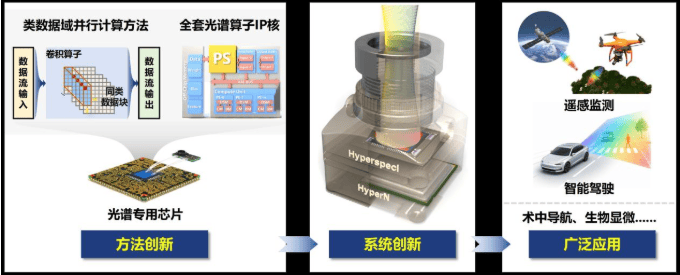
Leveraging this original architecture, the team completed a full engineering closed loop from theoretical exploration and chip development to complete system fabrication, successively overcoming a series of key technologies including high-density dataflow hardware acceleration, spectrum-specific computing chip fabrication, and lightweight AI spectral reconstruction networks. They independently developed the world's first integrated online real-time hyperspectral imaging microsystem—HyperVision.
The HyperVision system weighs only approximately 950 grams and consumes just 25.3 watts of power, reducing power consumption by an order of magnitude compared to traditional GPU-based solutions. It integrates a self-developed spectrum-specific computing chip and a broadband hyperspectral imaging sensor, paired with a high-capacity battery module and a high-definition display. Featuring advantages such as compact size, light weight, low power consumption, extended battery life, and strong intelligence, it operates without external power supply or reliance on external computing clusters, delivering stable video-level real-time hyperspectral imaging output across the visible-to-near-infrared broad spectral range.
The team has completed system validation tests in real dynamic scenarios, including intelligent driving, smoke monitoring, and drone-based air-to-ground imaging. Reviewers praised the achievement as "a deep optimization of system architecture" and "a significant technological advancement," possessing "rare engineering maturity."
In 2024, Zhang Jun's team overcame the challenge of on-chip optical encoding and published a paper in Nature. This latest achievement further tackles the computing bottleneck. HyperVision has bridged the entire chain of hyperspectral imaging technology—from laboratory theory to lightweight portable equipment and real-time online sensing applications—opening vast new possibilities for strategic emerging fields and new-quality industrial tracks such as aerospace remote sensing, intelligent driving, smart agriculture, and precision medicine.