
On September 2, the team at the Qingdao Institute of Bioenergy and Bioprocess Technology, Chinese Academy of Sciences (hereinafter referred to as "QIBEBT"), recently made a series of advances in the field of uranium extraction materials from seawater. For the first time, the team introduced discrete molecular topology design into porous organic cage systems, synthesizing the phosphate-functionalized material PhosCage; they further combined it with aramid nanofibers to produce composite aerogel microspheres AC-POC with high selectivity, high capacity, and antifouling resistance. The related findings were published in the international academic journals Journal of Hazardous Materials and Separation and Purification Technology.
The deep ocean harbors a vast "uranium reservoir," yet extracting uranium economically and efficiently remains a global challenge. Uranium in seawater exists primarily in the form of uranyl ions, at extremely low concentrations, accompanied by numerous other metal ions and microorganisms. Traditional adsorbent materials often "capture the wrong targets" or are disrupted by microbial adhesion. Therefore, developing adsorbent materials with high selectivity, high capacity, and antifouling resistance is key to making seawater uranium extraction practical.
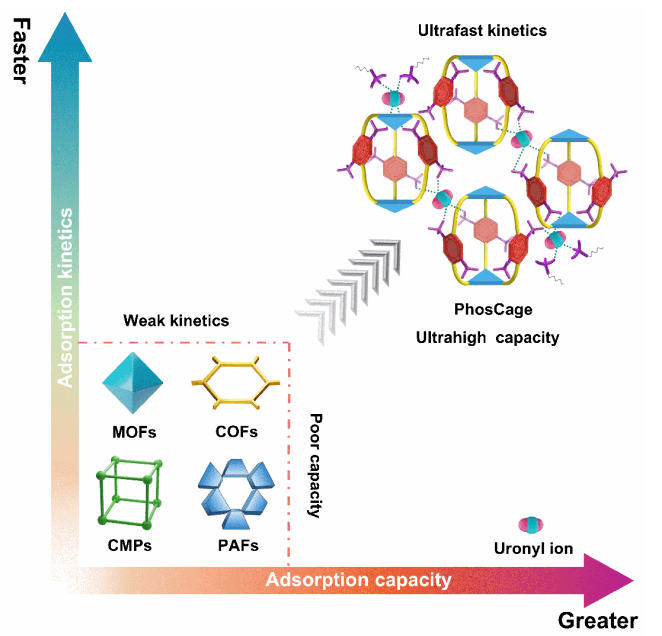
In this study, the QIBEBT team proposed a discrete molecular topology design strategy, constructing phosphate adsorption clusters directionally within the interlayer nanospace of porous organic cages, and prepared the first phosphate-functionalized porous organic cage material—PhosCage. Under laboratory conditions, PhosCage reaches adsorption equilibrium in just 5 minutes; in real seawater samples from multiple marine regions, its maximum uranium extraction capacity reaches 50.4 mg/g, which is 8.4 times the relevant benchmark set by the U.S. Department of Energy.
To enable the practical application of this material in marine engineering, challenges such as the difficulty of deploying powder materials and microbial adhesion must also be addressed. To this end, the team combined PhosCage with aramid nanofibers, synergizing physical entanglement and chemical cross-linking, to scale up the production of dual-network composite aerogel microspheres AC-POC. The microspheres feature interconnected pore channels, and their interwoven phosphate and carboxyl groups construct a powerful synergistic electron-donating coordination environment, effectively lowering the coordination energy barrier for uranyl ions—the energy threshold that must be crossed before a chemical reaction occurs. This makes the capture reaction more readily achievable, thereby enhancing the efficiency of uranyl ion capture.
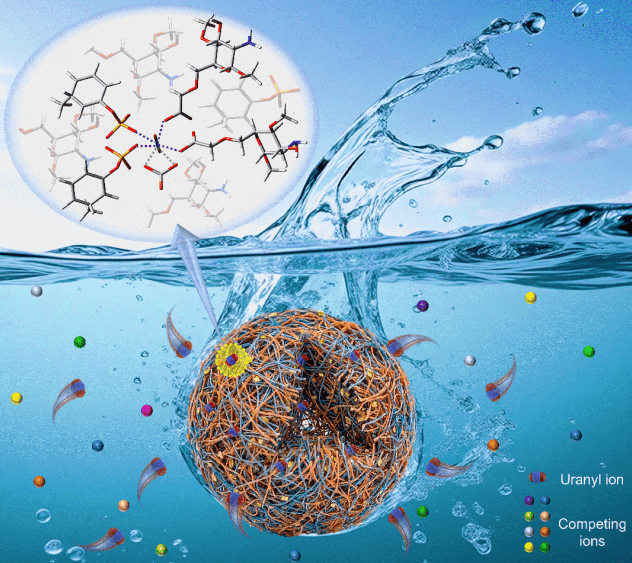
The research shows that AC-POC exhibits high selectivity in multi-ion competitive systems; after 15 days of continuous operation in natural seawater, its dynamic uranium extraction capacity reaches 22.55 mg/g, which is 3.8 times the relevant benchmark of the U.S. Department of Energy. Meanwhile, the negative surface charge of the microspheres inhibits microbial adhesion and biofilm formation, contributing to improved material stability in real marine environments.
This research fills the gap in the application of porous organic cage materials in seawater uranium extraction and lays a theoretical and engineering foundation for the design of sustainable seawater uranium adsorbent materials with high antifouling performance, high selectivity, and high capacity.