
Why is it increasingly difficult for the universe to form new stars? A popular explanation is that the "fuel" for nurturing stars—cold gas—is being continuously depleted, leading to a decline in star-forming activity. However, the latest joint observations by "China's FAST" (Five-hundred-meter Aperture Spherical radio Telescope) and the Dark Energy Spectroscopic Instrument (DESI) have yielded an unexpected answer: although star-forming activity in the universe has significantly weakened over the past 4.5 billion years, neutral hydrogen—a crucial reserve of cold gas—has not been depleted in tandem. The universe's "fuel tank" still has reserves, and the problem may lie in the "processing" stage. The research findings were published online in the journal *Nature Astronomy* on the 1st.
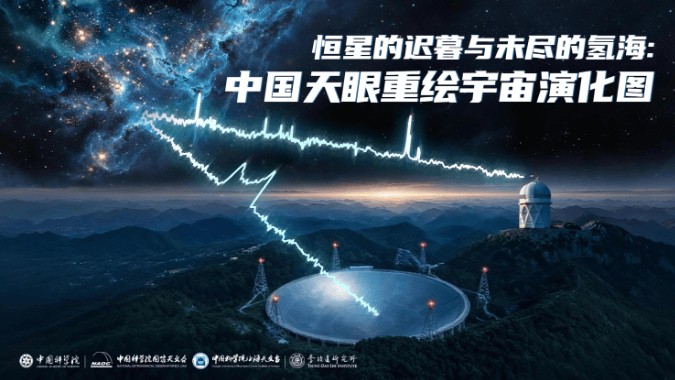
Neutral hydrogen is a key link connecting the large-scale gas cycle of galaxies with their internal star formation. It emits signals through the extremely faint 21-centimeter radio spectral line. For distant galaxies, individual signals are often drowned out by background noise, much like trying to hear a person's whisper in a noisy square. As a result, reliable evidence on how the total amount of neutral hydrogen in the universe has evolved has long been lacking.
In this study, an international collaborative team comprising the National Astronomical Observatories of the Chinese Academy of Sciences, the Shanghai Astronomical Observatory of the Chinese Academy of Sciences, and Shanghai Jiao Tong University, among others, deeply combined FAST's high-sensitivity radio observations with DESI's large-scale spectroscopic survey. They analyzed approximately 2.5 million galaxies covering about one-third of the sky, tracing the evolution of neutral hydrogen in the universe with unprecedented statistical precision.
"We used the neutral hydrogen spectral line stacking technique, precisely aligning and stacking a large number of faint signals that cannot be individually detected directly, based on galaxy distances. This is equivalent to having millions of faint voices shout the same sentence simultaneously, finally extracting the average signal from the noise," explained Zhang Chuanpeng, first author of the paper and associate researcher at the National Astronomical Observatories of the Chinese Academy of Sciences.
The measurement results show that the star formation rate in the universe 4.5 billion years ago was approximately 2.5 times higher than today, while the neutral atomic hydrogen density at that time was only about 1.4 times higher than today. In other words, while star-forming activity has "plummeted," the neutral hydrogen reserves in the universe have not been depleted in tandem. "If 'fuel depletion' were the main cause, both should have declined in step, but the data does not support this claim," said Guo Hong, corresponding author of the paper and researcher at the Shanghai Astronomical Observatory of the Chinese Academy of Sciences.
So where does the problem lie? Zhang Chuanpeng explained that stars are not formed directly from neutral hydrogen. Neutral hydrogen must first transform into denser molecular hydrogen clouds, which are the true "delivery rooms" for stars. What has truly undergone significant change in the late universe may be the conversion process of gas from neutral hydrogen to molecular hydrogen, and then to stars. As gas supply weakens and gas density decreases, the efficiency of converting neutral hydrogen into molecular hydrogen declines. Consequently, neutral hydrogen reserves are preserved relatively stably, while the molecular gas that can truly directly nurture stars is gradually diminishing.
"What we are seeing is not a universe running out of gas, but gas that is increasingly difficult to 'process' into stars," Guo Hong stated. This discovery shifts the focus of discussion from "whether gas is depleted" to "why gas exists but cannot be utilized," providing new key clues for understanding the decline of star formation in the universe.