
Scientists from RMIT University in Australia and the Conservatoire National des Arts et Métiers in France have jointly developed the world's first titanium-polymer open-cell hybrid lattice metamaterial. It not only floats on water but also resists seawater corrosion better than the stainless steel or high-density plastics currently used in docks, buoys, and floating sensors. This new invention overcomes the fundamental challenge of metal lattice structures being unable to float, and the related paper was published in the latest issue of Advanced Materials.
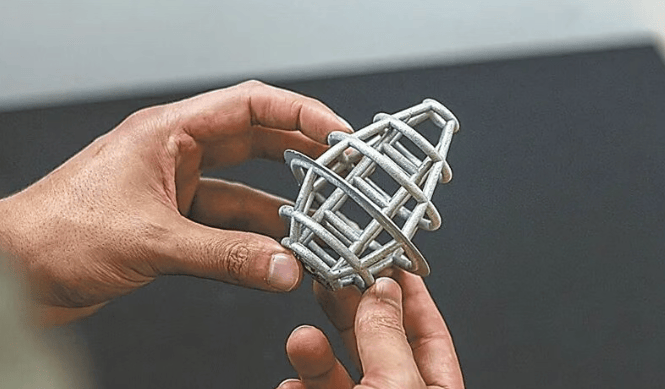
A 3D-printed buoy used in testing. Image credit: RMIT University
Metal lattice metamaterials have shown transformative potential in fields such as biomedicine, aerospace, defense, and thermal engineering, but their application in the marine sector has long been hindered. The reason: although metal lattices can be extremely light—with densities less than one-tenth that of water—their open, interconnected spaces allow water to enter, causing the structure to sink.
In the latest study, the team filled hollow titanium struts with polyurethane foam to create this new structure. Even after severe cracking or damage, with water flowing through it, the structure still floats. Samples remained afloat in fresh water for over two months, confirming their lasting buoyancy.
The team proposed a new method called "skeletal density" to determine whether an open structure can float. Traditional density calculations include all open spaces within the lattice structure in the volume, but once these spaces fill with water, they contribute nothing to buoyancy. Skeletal density, by contrast, only accounts for the parts of the structure that do not take on water, such as titanium walls and channels sealed with foam. This provides engineers with a simple design guideline: as long as the skeletal density is lower than the density of the surrounding liquid, the structure will float even if water flows through all external openings.
Tests showed that at the same overall density, the new titanium structure is 70% stronger than the stainless steel or high-density polyethylene widely used in marine applications. It also performed well in short-term seawater corrosion tests—after two weeks of immersion, the lattice lost only 0.15% of its mass, with a strength reduction of less than 1%.
More importantly, the hybrid lattice retains buoyancy even under severe damage such as cracking, failure of critical connection points, or even fracture of entire lattice layers. It only sinks when severely crushed and compacted. This highlights its potential to remain afloat despite significant structural damage.
Using the new structure, the team 3D-printed a marine buoy that remained stable even when tilted up to 45 degrees in a turbulent seawater tank, without the need for sealed casings, protective coatings, or additional floats.