
On September 17 at 10:40 Beijing time, the Kuaizhou-11 Y3 launch vehicle sent Tianyi 51 and 52 satellites into their designated orbits from the Jiuquan Satellite Launch Center. The flexible perovskite photovoltaic modules independently developed by Yanhe Technology entered orbit aboard the Tianyi 52 satellite and officially commenced long-term in-orbit performance monitoring and space environment adaptability verification. This mission will focus on obtaining data on the modules' power generation performance, stability, and environmental adaptability under real orbital conditions.
Yanhe Technology defines this mission as the first module-level, full-operating-condition engineering in-orbit verification of flexible perovskite in China's commercial space sector. The company had previously completed ground-based environmental simulation testing of related space-grade perovskite cells and modules, and advanced the development and delivery of in-orbit verification payloads. Its public information shows that its self-developed tandem perovskite cell modules have completed simulated extreme cosmic environment testing, with subsequent verification efforts shifting toward long-term operational performance in real space environments.
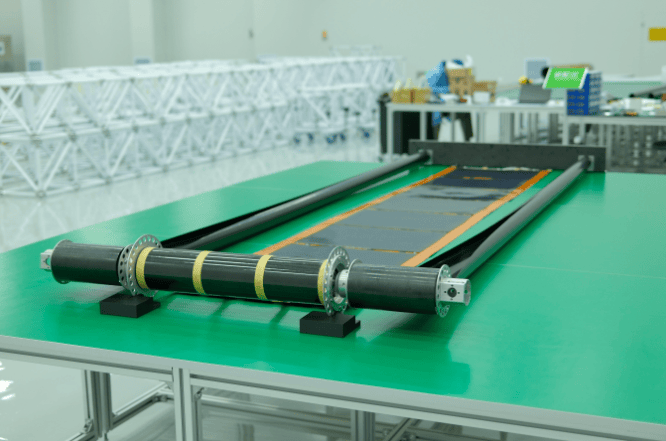
This in-orbit verification covers not only single-cell performance but module-level engineering operational status. The testing cycle will conduct continuous monitoring of orbital irradiation, temperature cycling, vacuum environment, and long-term power output, accumulating data for subsequent solar-wing-level product design, encapsulation system optimization, and space application parameters. Yanhe Technology had previously completed the finalization of the "Nebula" perovskite flexible rollable space solar wing engineering prototype. This prototype adopts a scroll-type integrated structure that can be rolled and stowed during the launch phase and deployed in orbit through a passive drive mechanism.
Within the year, Yanhe Technology also plans to continue advancing in-orbit verification of multiple technology routes, including flexible silicon, perovskite/HJT tandem, perovskite/CIGS tandem cells, as well as module arrays and full-wing solar wings. The company had previously signed a strategic cooperation framework agreement with Hangsheng Satellite, with both parties planning joint research and development around lightweight, high-packing-ratio, high-efficiency satellite solar wings, and proposing to complete the launch of no fewer than 10 test satellites carrying jointly developed perovskite solar wings by 2026.
Yanhe Technology has currently established a perovskite space photovoltaic pilot production line and a space-use perovskite crystalline silicon tandem trial line, and has laid out space photovoltaics, space computing power, and deep space energy applications. Its public information shows that its flexible thin-film solar wing solutions achieve a photoelectric conversion efficiency exceeding 20%, a mass-specific power of approximately 200W/kg, and an in-orbit design life of up to 8 years.
Following this mission, Yanhe Technology will continue to advance module-level, array-level, and full-wing-level in-orbit verification, and conduct continuous testing around the space adaptability, power retention rate, and long-term reliability of different cell systems.