
The team led by Jiang Zhongyi and He Guangwei at Tianjin University has successfully developed a novel all-organic mixed matrix membrane, breaking through the bottleneck of simultaneously achieving membrane separation performance and processability, and providing a new material pathway for low-energy, low-cost carbon capture from industrial gases. This achievement was published online on October 7 in the internationally top-tier academic journal Nature Energy.
Carbon capture is an important component of achieving the "dual carbon" goals. So-called "carbon capture" refers to capturing carbon dioxide released into the atmosphere, compressing it, and sequestering it in depleted oil fields or other safe underground locations.
Industrial gases emitted by power plants, cement plants, steel mills, and others have low carbon dioxide concentrations but very large total volumes. To "sieve" them out, traditional methods are energy-intensive and costly. Membrane separation technology is green, low-carbon, and energy-saving, and is considered a highly promising carbon capture technology.
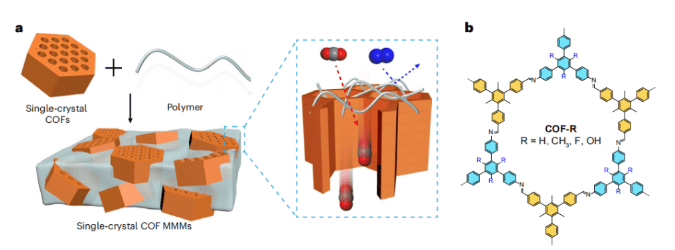
Schematic illustration of a single-crystal covalent organic framework all-organic mixed matrix membrane (photo provided by the interviewee)
The membrane is the "sieve" of membrane separation technology. Carbon capture from industrial flue gas requires membranes to combine high permeability, high selectivity, long-term stability, and ease of scaling up. Mixed matrix membranes combine the processability of polymers with the efficient transport capability of porous fillers, occupying an important position in low-energy carbon capture. However, the two types of materials have vastly different properties, creating compatibility issues. Traditional methods rely on enhancing interaction forces to "stick" the two types of materials more firmly together, but the effect is limited. Separation performance is still dominated by the polymer, and the porous fillers are hard-pressed to play a role.
In response, inspired by cell membrane structures, the research team proposed a "weak interfacial force embedding" strategy, compositing single-crystal covalent organic frameworks (COFs) with regular ordered channels with polymers to develop an all-organic mixed matrix membrane. By coordinating "filler-polymer" and "filler-filler" interactions, the COFs are uniformly "embedded" into the membrane at high loading, truly "playing the leading role" in molecular transport, while preserving the membrane's flexibility and solution processability, constructing ultrafast carbon dioxide transport channels.
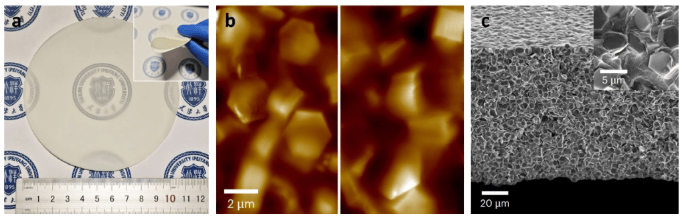
Schematic illustration of membrane morphology and microstructure (photo provided by the interviewee)
In simulated flue gas mixture tests, the all-organic mixed matrix membrane prepared by the team achieved an order-of-magnitude improvement in carbon dioxide permeability, breaking the literature record and reaching approximately 70% of the theoretical value of a pure COF membrane predicted by the model. The membrane also demonstrated good long-term stability, maintaining stable performance under test conditions containing moisture, sulfur oxides, and nitrogen oxides. Preliminary techno-economic analysis indicates that under the set process and cost conditions, the carbon capture cost is approximately 38 USD per tonne of carbon dioxide.
"Transforming the challenge of industrial carbon emission reduction into a scientific problem of high-end membrane materials is the direction of our long-term research," said Professor Jiang Zhongyi, corresponding author of the paper. This achievement provides new ideas for developing membrane materials that balance performance, stability, and processability, and is expected to be applied in flue gas carbon capture in the power, cement, steel, and other industries, thereby driving carbon capture membrane technology toward industrial application.