
The coldest known "freezing point" in the universe is not in distant deep space, nor deep beneath the Antarctic ice sheet, but on the China Space Station.
Recently, the Technology and Engineering Center for Space Utilization of the Chinese Academy of Sciences held a China Space Station achievement release conference and announced that, using the China Space Station's ultracold atomic physics experiment rack, Chinese scientists successfully prepared a rubidium atomic cloud with a temperature of only 9.7 picokelvin, 14 orders of magnitude lower than room temperature, and were able to observe it continuously for 7 seconds. The related research results were published online on the 6th in the international academic journal Science.
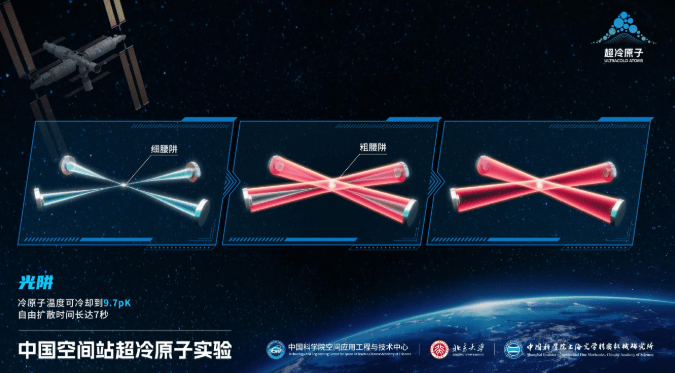
This atomic cloud is the coldest artificial matter currently known, with a temperature only about 9.7 trillionths of a degree Celsius above absolute zero, setting a record for the lowest temperature known to humankind and marking a major step by Chinese scientists toward absolute zero (-273.15°C).
Temperature essentially reflects the intensity of atomic motion. The lower the temperature, the slower the atoms move. When atoms are cooled to near absolute zero, they no longer move randomly but become orderly and exhibit peculiar quantum phenomena such as Bose-Einstein condensation. "Atoms in this state are like a well-trained 'honor guard,' making it easier for scientists to study the quantum world and carry out frontier research such as precision measurement and quantum simulation," explained Zhou Xiaoji, a professor at the School of Electronics of Peking University and co-corresponding author of the paper.
However, on the ground, gravity pulls atoms down from the bottom of the "cage," limiting the cooling effect. The space station is in a microgravity environment, where the confinement on atoms can be very weak, the cooling effect is better, temperatures can be lowered further, and observations can last longer.
To take advantage of microgravity and achieve better cooling effects, the Technology and Engineering Center for Space Utilization of the Chinese Academy of Sciences, Peking University, and the Shanghai Institute of Optics and Fine Mechanics of the Chinese Academy of Sciences jointly developed the ultracold atomic physics experiment rack.
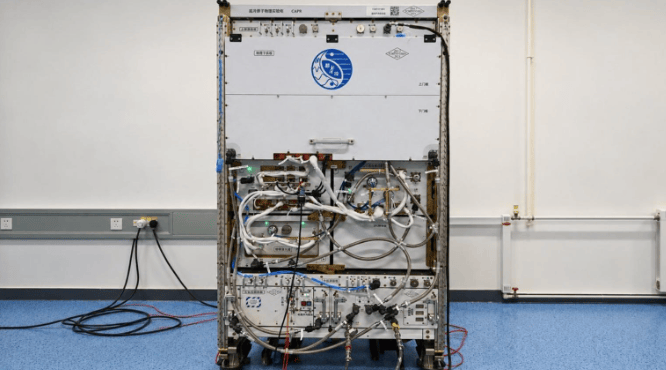
Simply put, this experiment rack is a "super refrigerator" in space. This "super refrigerator" contains about 5 grams of metallic rubidium. Researchers first heat the rubidium to evaporate it and release rubidium atomic vapor; then use lasers and magnetic fields to "enclose" the atoms for preliminary cooling; subsequently adopt the all-optical trap cooling scheme proposed by the Chinese team, using lasers to create an invisible "cage" to "imprison" the atomic cloud and further "calm" the atoms by reducing light intensity; finally, use non-adiabatic diffusion for deep cooling, step by step pressing the temperature down to 9.7 picokelvin.
Unlike the atom-chip magnetic trap scheme commonly used internationally, China's optical trap scheme is more difficult but has obvious advantages: precise control of multiple laser beams is easier to achieve in space, it is less susceptible to magnetic field interference, and it facilitates various quantum simulation experiments. "Previously, there was no international precedent for preparing condensates in orbit through optical trap evaporative cooling technology. We proposed a new scheme assisted by gradient forces to achieve efficient evaporative cooling of atoms and ultimately obtained a high-purity condensate, which is expected to lead to the discovery of new physical phenomena in the future," said Zhou Xiaoji.
In fact, developing this "super refrigerator" was not easy. The project began demonstration in 2011, was successfully developed in 2022 and launched into space with the "Mengtian" experiment module, and has now achieved a major breakthrough, spanning 15 years.
"The experiment rack involves many fields such as atomic physics, laser technology, precision optics, ultrahigh vacuum, automatic control, and aerospace engineering, and must also meet the requirements of high integration, low power consumption, and high reliability for spaceflight. More importantly, we overcame various engineering challenges and successfully compressed a ground experimental system of 20 cubic meters and 10 tons into an experiment rack of 0.7 cubic meters and 0.5 tons, equivalent to fitting room-sized equipment into a refrigerator," said Li Tang, a researcher at the Shanghai Institute of Optics and Fine Mechanics of the Chinese Academy of Sciences and co-first author of the paper.
Reviewers of Science commented that this achievement is an important milestone in the precision manipulation of ultracold atoms, has important value for basic physics research and applications such as space navigation and Earth observation, and sets a new record for ultralow-temperature expansion. Wolfgang Ketterle, Nobel laureate in physics and professor in the Department of Physics at the Massachusetts Institute of Technology, also said, "This is a major achievement in the field of ultracold atoms" and "this achievement is a good starting point that can advance atomic temperature measurement and precision measurement."
At the release conference, Lü Congmin, chief designer of the space application system of China's manned space engineering program and deputy director of the Space Utilization Center, said: "Absolute zero can never be reached, but humanity's steps toward it will never stop. We welcome everyone to conduct experimental research at the China Space Station's ultracold atomic physics experiment rack, share experimental opportunities, and jointly make new contributions to the progress of human science and technology."