
On November 6, the world's first 4000-meter-class floating wind power system successfully completed a test flight in Yueyang, Hunan, marking the first time a 4000-meter-class floating wind power system has completed a launch test in an urban scenario.
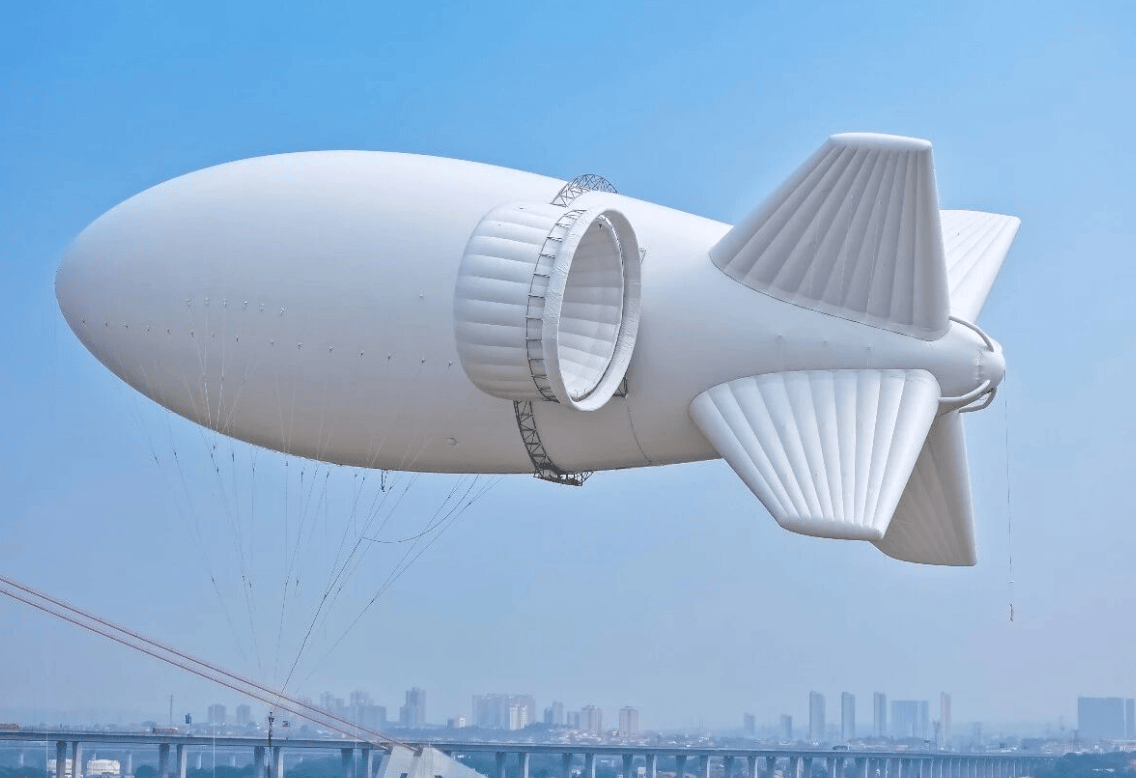
Following the takeoff command, the S4000 floating wind power system slowly ascended to conduct verification of multiple subjects, including attitude stability control under complex airflow conditions and power generation performance under complex magnetic fields. The S4000 floating wind power system that completed the launch verification this time has a length of 67 meters, a width of 40 meters and a height of 23 meters, can ascend to an altitude of 4,000 meters, has an output voltage ranging from 10 kV to 35 kV, and has a designed service life of 20 years. The system uses a helium-filled floating platform to send lightweight power generation modules to an altitude of several thousand meters, where it continuously generates electricity using stable high-altitude wind resources, and the electricity generated is then transmitted back to the ground via tethered cables.
Dun Tianrui, chief architect of the floating wind power system, said that what needs to be tested more today is its grid-connection performance, namely whether it will interfere with power and attitude stability when the generator is running. The urban test flight examines "whether it can fly safely and reliably around citizens and crowds." Cities are the core areas of electricity consumption, and ultimately these power supply systems still need to move toward more densely populated areas.
As a new energy "no man's land" that has not yet been developed at scale, high-altitude wind energy has advantages such as high wind speed, stable wind direction and high wind energy density, and holds enormous potential. At present, there are mainly two technical routes: ground-based and airborne. The ground-based approach keeps heavy generators on the ground and uses airborne components such as parafoils and aerostats to pull tethers and do work; the airborne approach sends generator units into the sky with aerostats to generate electricity in place at high altitude. In August this year, the S4000 floating wind power system completed full-process verification at 4,000 meters at a test base in northwest China, verifying its extreme adaptability under conditions of high altitude, strong ultraviolet radiation and large temperature differences.
Cai Rong, a researcher at the Aerospace Information Research Institute of the Chinese Academy of Sciences, said that this urban-scenario test flight verified the reliability of the entire floating system, and also verified the feasibility and completeness of engineering delivery under real working conditions around cities, as well as the capability for rapid on-site deployment. It opened up the key links of research and development, testing and operation, paving the way for airworthiness certification and scenario demonstration, and strongly promoting high-altitude wind power equipment from technical verification toward industrial implementation.