
On November 9, US deep-sea mining technology company Impossible Metals released the deep-sea test results of its Eureka autonomous underwater vehicle. In September 2026, the robot conducted a scientific expedition in the Clarion-Clipperton Zone of the Pacific Ocean, diving to a seabed depth of more than 4,000 meters, where it used autonomous recognition and a robotic arm to selectively collect approximately 450 grams of polymetallic nodules and brought the samples back to the surface. The test completed the full process of deep-sea autonomous navigation, target recognition, nodule collection, and sample recovery, validating a robotic collection technology that does not require subsea riser pipes.
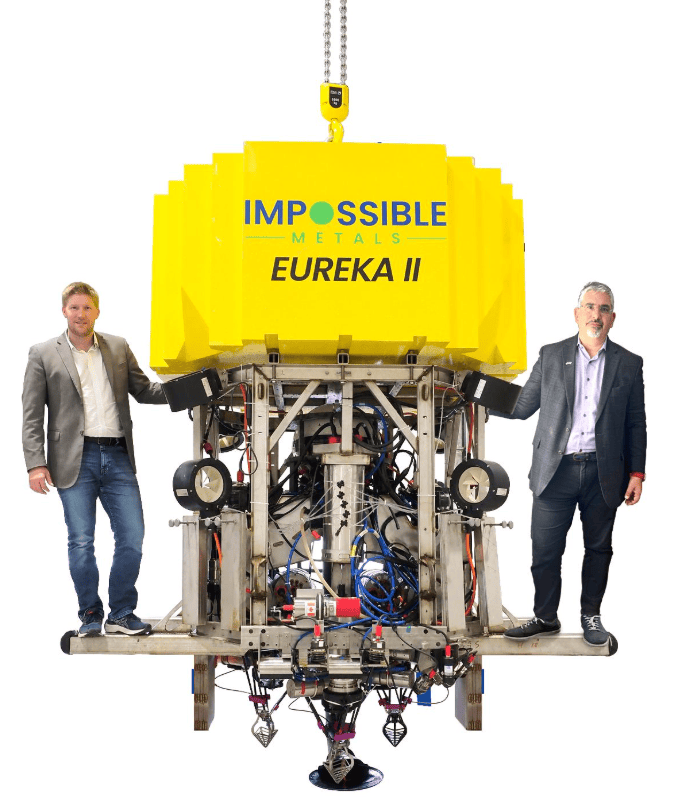
Eureka employs a suspended operating configuration, using its onboard perception system to identify polymetallic nodules on the seabed and the visible organisms around them, after which a robotic arm grasps the selected nodules. The robot hovers above the seabed during operation, without relying on tracks to contact the seabed and without using a conventional riser suction system to transport ore. Its buoyancy adjustment device completes payload lifting by changing displacement, enabling the robot to carry collected samples and return autonomously to the surface.
The approximately 450 grams of polymetallic nodules obtained in this test will be handed over to research partner Viridian Biometals for analysis of nodule-associated microbial communities and for research on using bacteria to extract metals from polymetallic nodules. The research involves bioextraction technology for metals such as copper and nickel, and plans to evaluate treatment processes that reduce water consumption, energy consumption, and the use of acidic reagents. This deep-sea collection was part of a marine scientific research mission, and the recovered quantity is at the scale of scientific sampling.
Impossible Metals' robotic system has been granted US Patent No. US 12,704,065, with an authorization date of August 11, 2026. The patent covers technologies including buoyancy-driven operation, selective collection by robotic arm, and seabed organism recognition. The company plans to provide collection equipment and operational services through a robotic service model to operators holding deep-sea mineral resource licenses, and to expand subsequent collection capacity through the coordinated operation of multiple autonomous robots.
The next stage of development will shift to a larger collection robot, Eureka III. The company plans to conduct a new round of deep-sea testing in 2027 using the German research vessel RV SONNE (RV SONNE) in an environmental impact study organized by the German Federal Institute for Geosciences and Natural Resources, with an independent scientific research team assessing the equipment's operation and its impact on the seabed environment. The plan will continue to focus on validating robotic collection capability, operational processes, and environmental monitoring.