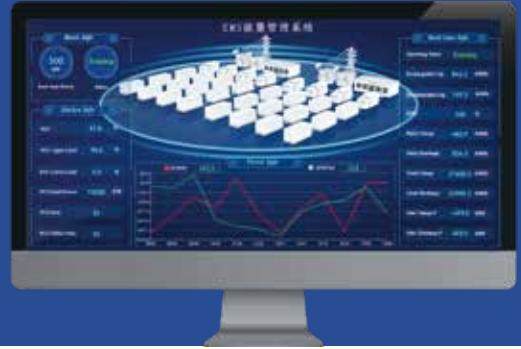


GC Master EMS is an independently developed energy management system for the energy storage industry, featuring data acquisition, monitoring, and energy regulation control functions. By optimizing energy storage control, distributed generation output, and load connection/disconnection, the system safely, economically, and efficiently realizes energy management and control under different application scenarios (generation side, grid side, user side, and ancillary services) and different operating modes, achieving safe and optimized energy dispatch.
6 Core Advantages
Cross-platform
Supports cross-platform operation, compatible with domestic databases (MYSQL, Dameng, Renmin Jincang, etc.) and domestic operating systems (Windows, Linux, Kylin, Unity, etc.)
Modular Configuration
Modular design concept, compatible with various protocols, standards, and strategies required for PV-storage and microgrid operation
Million-level Data
Through analysis of million-level data, graphically reconstructs accident-related processes in real scenes
Data Mining and Analysis
Large-capacity data acquisition system, efficient processing of massive data, stable data preservation mechanism
Energy Optimization Management
Full life-cycle management, energy optimization algorithms
Customized Intelligent Strategies
Capable of customized development for various functions and strategies such as fluctuation suppression, inertia support, primary frequency regulation, scheduled curve, anti-reverse power flow, demand control, etc.
Function Overview
-
Real-time Monitoring: battery, PCS, load, wind power, PV, auxiliary systems
-
Operation & Maintenance Management: collect energy storage operation data, integrate whole-station data information
-
Advanced Control: AGC/AVC, primary frequency regulation, scheduled curve, fluctuation suppression, system peak shaving, automatic SOC maintenance
-
Partitioned Control: system security zoning, control security grading
-
Real-time Control: internal energy control of energy storage and microgrid, maintaining grid power balance
-
Advanced Applications: diagnostic warning, panoramic analysis (station efficiency, cost, energy conversion analysis)
-
Intelligent Optimized Dispatch Strategies: anti-reverse power flow, demand control, load tracking, etc.