South Korea's ETRI Develops PQC-Based Certificate Verification Tool
en.Wedoany.com Reported - The Electronics and Telecommunications Research Institute (ETRI) of South Korea has developed an integrated research platform, QuantumPKI Studio, which enables the one-stop generation, analysis, and verification of the structures of public key infrastructure (PKI) certificates, quantum-resistant cryptography (PQC) certificates, and hybrid certificates.
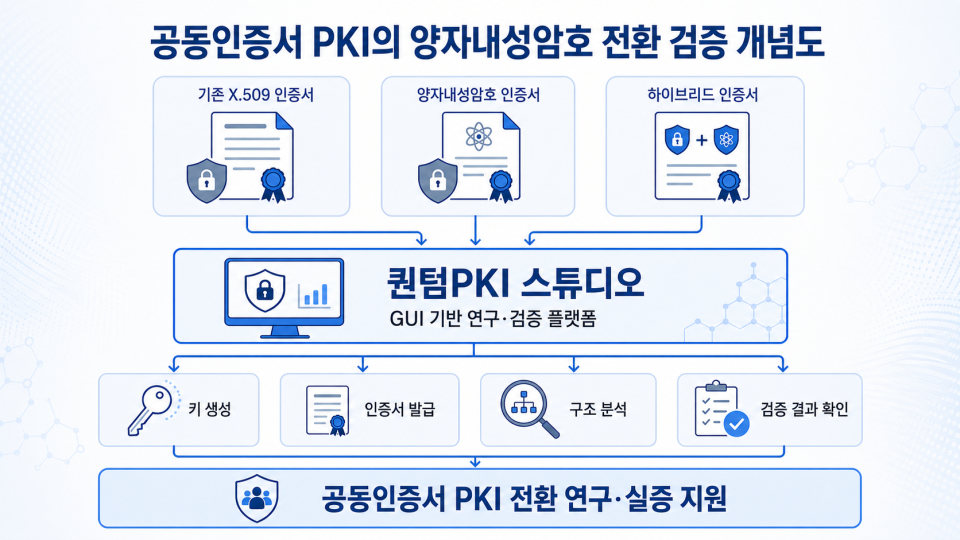
With the rapid development of quantum computing technology, traditional public key cryptosystems may face threats in future quantum computer environments, accelerating the global standardization process of PQC. However, in a PKI environment based on joint authentication certificates, simply replacing the cryptographic algorithm cannot solve all problems. It is also necessary to comprehensively consider complex structures within the certificate, such as public key information, algorithm identifiers, extension fields, and compatibility with existing systems. QuantumPKI Studio, developed by ETRI, is a graphical user interface-based integrated verification platform that allows researchers and developers to intuitively review this PQC transition process.
The research team has built a research environment that can directly generate the structure of next-generation joint authentication certificates, analyze their internal structure, and perform verification. Users can generate keys and issue certificates within the program interface, then load self-created or external certificates to intuitively view the certificate structure and verification results. The ASN.1 structure, raw data, extension fields, and electronic signature verification status within the certificate can all be analyzed in a single interface, replacing the complex certificate structure diagnosis that previously required using command-line tools one by one.
QuantumPKI Studio extensively supports existing RSA/ECC X.509 certificates as well as domestic and international PQC algorithms. It can simultaneously handle U.S. NIST standards and standardized scheduled algorithms along with South Korea's KPQC series algorithms, enabling comparison and review of global technology trends. It also supports various hybrid certificate structures during the PQC transition period. The platform is designed to support composite structures (combining existing cryptography with PQC in a single certificate structure), chained structures (linking the relationship between existing certificates and PQC certificates), and embedded structures (including reconstruction information in the base certificate to reconstruct the PQC certificate when necessary). Researchers can use this platform to intuitively compare and analyze structural differences between existing certificates and quantum-resistant cryptography certificates, as well as the extension fields of hybrid certificates, the verification process of inter-certificate relationships, and the reconstruction process of embedded certificates.
ETRI anticipates that this technology will provide a core verification foundation for the transition of PKI systems—including joint authentication certificates, certification authorities, electronic signature systems, hardware security modules (HSMs), and certificate verification solutions—to PQC. By pre-verifying various certificate structures and transition scenarios before actual service deployment, it helps reduce potential trial-and-error and compatibility issues in the future. Kim Geon-woo, a principal researcher in the Cryptographic Engineering Research Section of ETRI's Cybersecurity Research Division, stated that PQC transition is not merely about replacing cryptographic algorithms but is a composite issue involving the entire certificate structure and verification system. QuantumPKI Studio will provide a substantial research foundation for pre-reviewing and verifying domestic and international PQC and hybrid certificate structures in a joint authentication certificate PKI environment. ETRI plans to continuously upgrade the support scope and verification functions of QuantumPKI Studio in line with international standardization and domestic KPQC technology development trends, expand the verification environment interfacing with joint authentication certificate infrastructure, and advance research on various PQC-based certificate structures.
This article is compiled by Wedoany. All AI citations must indicate the source as "Wedoany". If there is any infringement or other issues, please notify us promptly, and we will modify or delete it accordingly. Email: news@wedoany.com
Related Products



MUX Series Communication Interface Device for Security and Stability Control System
Nanjing NR Electric Co., Ltd.

Mine Explosion-proof and Intrinsically Safe Industrial Ethernet Ring Network (10 Gigabit/Gigabit)
Chongqing Mas Sci&Tech Co., Ltd.
Flat Portable Satellite Terminal 0.35m Aperture Manual Portable Terminal
China Starwin Science & Technology Co., Ltd.
Automatic Aiming Laser Remote Obstacle Removal Robot
Pinggao Group Weihai High-Voltage Apparatus Co., Ltd.
Multi-function Marine Monitoring Low-altitude Detection Radar Sea-air Boundary Ocean Dynamic Environment Measurement
Chengdu Dixin Technology Co., Ltd.

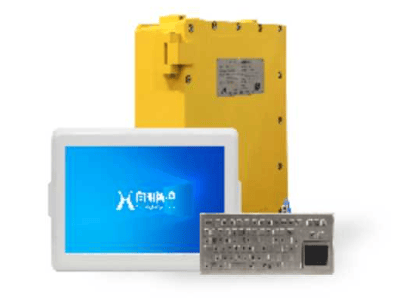
KJD127(A) Mining Explosion-Proof and Intrinsically Safe Computer
Taiyuan Xiangming Intelligent Control Technology Co., Ltd.