South Korea's Upstage Launches 250-Billion-Parameter Agent Model
en.Wedoany.com Reported - South Korea's Upstage publicly released its self-developed open-weight large language model (LLM) 'Solar Open 2' on the 23rd. As a result of the government's 'Independent AI Foundation Model' project, the model has been published on the global open-source platform Hugging Face, along with a technical report detailing its architecture and learning methods.
Unlike its predecessor 'Solar Open 1', Solar Open 2 is specifically designed for agent purposes. It is capable not only of simple question-and-answer tasks but also of repeatedly processing tasks through dozens of reasoning steps and tool calls until completion. The model employs a Mixture of Experts (MoE) structure with a total of 250 billion parameters, but only activates 15 billion parameters during actual operation. By computing only the necessary parts, it improves efficiency in agent tasks that consume a large number of tokens. Compared to the predecessor's 102 billion parameters, this represents a 2.5-fold increase, while the number of layers remains unchanged at 48.
Solar Open 2 supports a long context processing capability of up to 1 million tokens, which is crucial for agent tasks that require continuous memory of task history and processing of large documents. To achieve this capability, Upstage grouped every 4 layers out of the 48, deploying a mix of one 'Softmax Attention' (high precision but computationally intensive) and three 'Linear Attention' (lightweight computation but compressed memory information) per group. This means only one-quarter of all layers use the Softmax method. Additionally, the model completely removes independent positional encoding devices, relying solely on the memory structure of Linear Attention to convey word order information. It also incorporates an extension technology that allows for self-correction of erroneously stored information through backtracking.
Upstage stated that the amount of training data required to achieve the same performance can be reduced by up to three times or more compared to the predecessor method. After applying quantization, the model can run on just two NVIDIA H200 chips, lowering the cost for enterprises to deploy on their own infrastructure. The technology introduced this time no longer trains hundreds of billions of parameter models from scratch each time. Instead, it selectively reuses parts from the weights of the predecessor 'Solar Open 1' that overlap with the new structure, inheriting only structurally identical components such as the vocabulary, output layer, and normalization layer. The newly generated parts and the increase in the number of experts from 128 to 320 are retrained. The reused weights account for only 2.3% of the total, but experiments show that this method can reduce the training required to achieve the same performance by approximately 1.7 times. The training data was reduced from the original 20 trillion tokens to 10 trillion tokens through quality filtering, with a ratio of 4:6 between real data and synthetic data. The proportions of mathematics and code were each adjusted to over 15%.
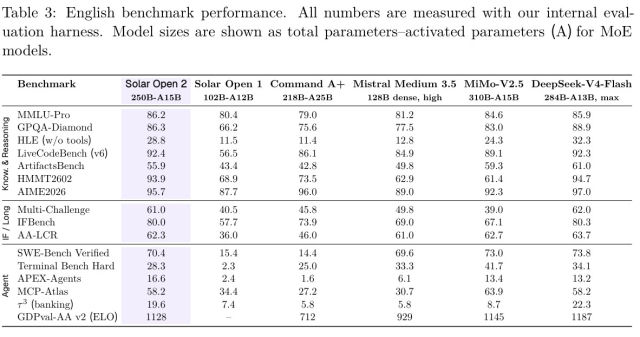
In performance tests, Solar Open 2 surpassed major open-weight models such as DeepSeek 'V4 Flash', Mistral 'Medium 3.5', and Cohere 'Command A+' in comprehensive knowledge (MMLU-Pro), programming (LiveCodeBench), instruction following and tool calling, and overall agent evaluation. Compared to its predecessor, its scores improved by over 20 points in key benchmarks such as knowledge and scientific reasoning, mathematics, and programming. In terms of Korean language capability, it scored higher than closed APIs like OpenAI 'GPT-5.4 Mini' and Anthropic 'Claude Haiku 4.5' in the average score of Korean benchmarks. Notably, it achieved a score of 86.8 in the 'Ko-GDPval' benchmark, approaching the performance of DeepSeek 'V4 Pro' (86.9 points), which is over six times larger. Upstage attributes this to its proprietary tokenizer specialized for Korean, which can represent the same Korean sentence with far fewer tokens than other global models, offering cost and speed advantages in agent tasks where task history accumulates. In evaluations such as 'SWE-Bench' and 'TerminalBench', which assess the ability to complete tasks in real software repositories or terminal environments, the model fell short of competitors like DeepSeek 'V4 Flash' and Mimou 'V2.5'. Upstage identified software engineering capabilities at the repository/terminal level and the fine numerical accuracy of office outputs as areas for future improvement.
Upstage has fully disclosed the weights of Solar Open 2 under the 'Upstage Solar License (based on Apache 2.0)', allowing commercial use and the freedom to develop derivative models. In the future, this model will be applied to the portal site Daum, acquired in May of this year, expanding from search/summarization to interactive agent services. Through the AI agent platform Timely, acquired in June of this year, it will support the introduction of agents by local governments and public educational institutions nationwide. Upstage plans to expand services based on Solar Open 2 to all industry sectors, including finance, law, healthcare, public services, defense, manufacturing, consumer goods, robotics, and education. It also intends to build a 'full-stack sovereign AI' combined with domestic neural processing units (NPUs) and will register the model on global platforms such as 'OpenRouter' and 'Hermes Agent' to expand the overseas developer ecosystem.
Related Products
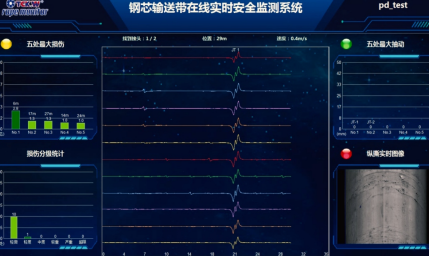

Conveyor Belt Intelligent Monitoring System
LUO YANG WIRE ROPE INSPECTION TECHNOLOGY CO., LTD.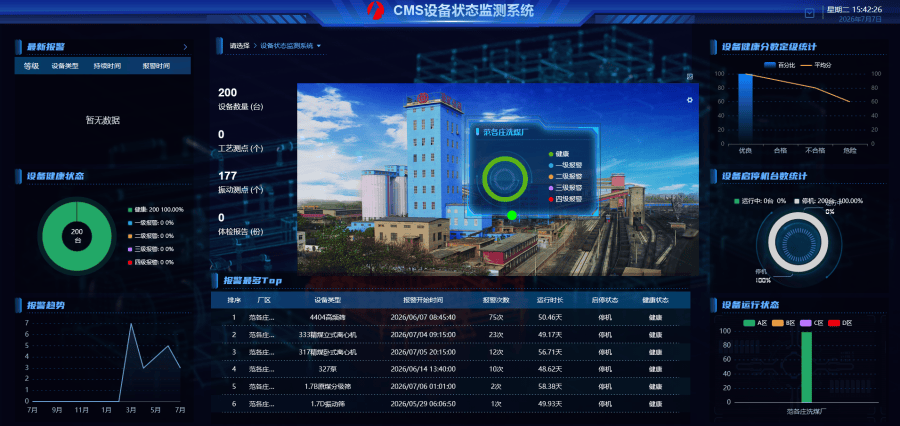

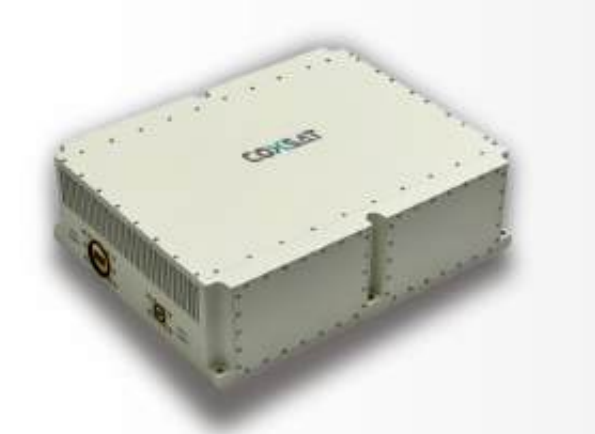

MUX Series Communication Interface Device for Security and Stability Control System
Nanjing NR Electric Co., Ltd.

Mine Explosion-proof and Intrinsically Safe Industrial Ethernet Ring Network (10 Gigabit/Gigabit)
Chongqing Mas Sci&Tech Co., Ltd.
TWP16 P-Band Tropospheric Wind Profile Radar
China Huayun Meteorological Technology Group Co., Ltd.
20 Inch 1600*900 Full HD 60Hz TFT LED Monitor with VGA and DP Interfaces for Desktop Computers-Business Use
Guangzhou Zanying Optoelectronics Technology Co., Ltd.