South Korea's OpenLabs Launches Agentic AI Development Engine Nuvida
en.Wedoany.com Reported - On July 23, South Korea's OpenLabs (오픈랩스) announced the launch of the agentic AI development engine Nuvida (누비다), which automates the entire process from analysis to construction of large-scale enterprise development projects.
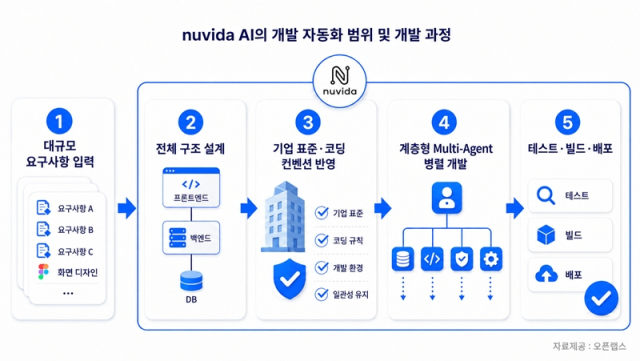
OpenLabs developed this engine based on global large language models (LLMs) and its proprietary LLM, combined with layered multi-agent technology optimized for enterprise development environments and its own AI engine.
Enterprise system development requires the consistent integration of interfaces, APIs, data structures, permissions, and business logic. Nuvida can receive large-scale requirements at once, first designing the overall application architecture including the database, then developing multiple functions in parallel based on that architecture, and automatically completing testing, building, deployment, and the generation of major deliverables.
Previous AI coding tools were primarily used for function-level code generation, making it difficult to analyze large-scale requirements at once or consistently reflect enterprise development standards and environments across an entire project. The more complex the requirements, the more the process of repeatedly requesting each function from AI and modifying the integrated results increases, leading to a rise in LLM call counts and token usage.
Nuvida, designed and developed based on the overall project, can reduce LLM call counts and token usage. Based on experience from projects in the South Korean financial sector, this engine applies enterprise development standards, providing an AI engine and LLM capable of efficiently analyzing, designing, and developing complex requirements.
The main features of this engine include: automatic design of databases and application architectures based on large-scale requirements, automatic publishing based on Figma design files, writing functional specification documents and automatic checking for missing requirements, automatic generation of unit test code along with test execution and result report writing, and consistent coding and deliverable writing that reflects each enterprise's development environment.
The Nuvida engine includes AI agents that take on roles from actual development organizations, such as Project Manager (PM), Data/Database Architect (DA/DBA), Application Architect (AA), Developer, and Quality Assurance (QA), each responsible for their specialized domain. A higher-level agent integrates and manages the results, enabling the development process to be organically connected. Developers can focus on setting development standards, accepting results, and developing core technologies, rather than repeatedly writing code.
The service is provided as Software as a Service (SaaS) and as an on-premises installation version (closed type). The installation version is designed for enterprise environments with restricted external network access or high security requirements. By applying Model Context Protocol (MCP) and Retrieval-Augmented Generation (RAG) technologies, it reflects each enterprise's coding standards, common functions, and development guidelines in the design and code generation process, and supports connecting internal technical materials and development know-how for use with the engine.
OpenLabs CEO Ha Chang-seok stated that the key to enterprise development lies in efficiently automating the entire development process and effectively utilizing AI through an AI engine that meets enterprise standards.
OpenLabs plans to subsequently add features for analyzing existing system source code and migrating to new environments, as well as maintenance support functions, expanding the scope of application from enterprise system development to the entire operational process.
Related Products

One-Stop Steward Service for the Entire Logistics System Integration Chain
Zhongding Intelligent (Wuxi) Technology Co., Ltd.



Conveyor Belt Intelligent Monitoring System
LUO YANG WIRE ROPE INSPECTION TECHNOLOGY CO., LTD.
GYTA Type Non-Self-Supporting Aerial/Duct Optical Cable
TONGDING INTERCONNECTION INFORMATION CO., LTD.
Automatic Aiming Laser Remote Obstacle Removal Robot
Pinggao Group Weihai High-Voltage Apparatus Co., Ltd.