Lijian-2 Y2 Carrier Rocket Completes Large-Scale Satellite Internet Constellation Deployment Launch
en.Wedoany.com Reported - At 08:15 on November 3, the CAS Space Lijian-2 Y2 carrier rocket lifted off from the Dongfeng Commercial Aerospace Innovation Test Zone, sending a total of 18 satellites in the Qianfan Polar-Orbit Group 21 into an 800-kilometer near-polar orbit. The flight test mission was a success; this marks the first time Lijian-2 has carried out a large-scale satellite internet constellation deployment launch.
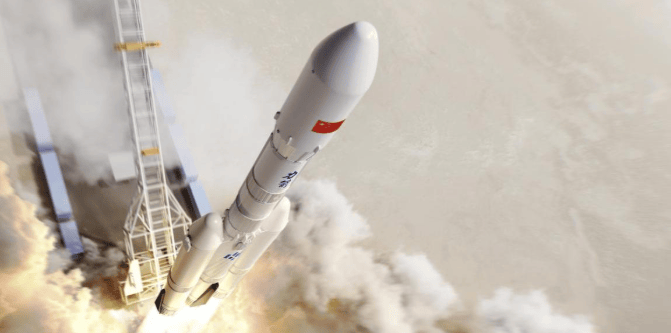
Lijian-2 for the first time applied a multi-satellite rocket-satellite inter-satellite separation mechanism unlocking device, with 18 satellites stacked and sharing a single separation mechanism to achieve "one-time unlocking." Traditional multi-satellite launches require unlocking and ejecting each satellite individually, involving multiple separation steps and a large number of mechanisms; the new scheme replaces sequential mechanism actions with kinematic design, whereby satellites are separated from one another by being released as a whole, resulting in fewer mechanisms and lighter weight. The device accommodates increases or decreases in satellite count through a scalable configuration, reducing repeated adaptation across different missions and directly serving the high-density launch demands of satellite internet constellation deployment.
Lijian-2 is China's first liquid carrier rocket with a "Common Booster Core" (CBC) configuration, composed of three essentially identical common core stages. The common core stage has a diameter of 3.35 meters, a payload capacity of 8 tonnes to a 500-kilometer sun-synchronous orbit, and a payload capacity of 12 tonnes to a 200-kilometer low Earth orbit. This mission also optimized the tank-bottom anti-slosh and propellant retention devices for longer coast durations, adopted a two-ignition scheme for the second-stage engine, and for the first time applied a pulse-width modulation-based variable-thrust settling scheme to improve propellant management efficiency.
On the constellation side, the Qianfan Constellation is built and operated by Shanghai Yuanxin Satellite. With the 18 satellites from this mission now in orbit, the total number of satellites in orbit has increased to 274, with more than 160 satellites launched cumulatively in 2026. According to the plan, the first phase of the Qianfan Constellation targets the deployment of 648 satellites, with 324 satellites planned to be in orbit by the end of 2026 to achieve basic regional coverage and initiate commercial operations; the long-term plan calls for more than 15,000 satellites. With the addition of Lijian-2, the launch service providers for the Qianfan Constellation now include the Long March series, Zhuque-2 Improved, Gravity-1, and other rockets, further expanding the capacity pool under parallel multi-supplier procurement.
To date, Lijian-2 has delivered a total payload mass exceeding 9 tonnes to orbit; the Lijian series of carrier rockets have cumulatively sent 1 spacecraft and 139 satellites into space, with a total payload mass exceeding 27 tonnes. CAS Space stated that it will subsequently expand the orbital coverage of Lijian-2 through the independently developed Lixun-1 upper stage and advance research on clustered recovery.