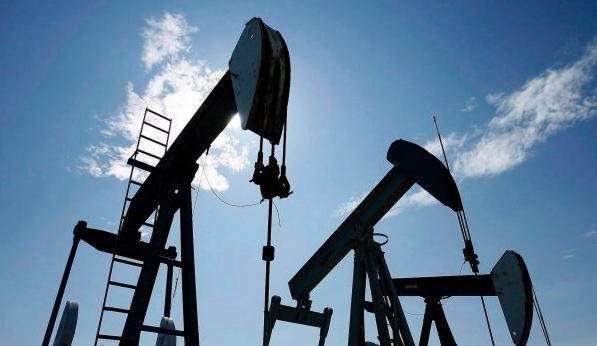
Wedoany.com Report-Sept. 13, On a mountain pass in Jiawa village, Qusum county, Shannan, southwest China’s Xizang autonomous region, rows of energy storage units operate beside a solar-storage power station.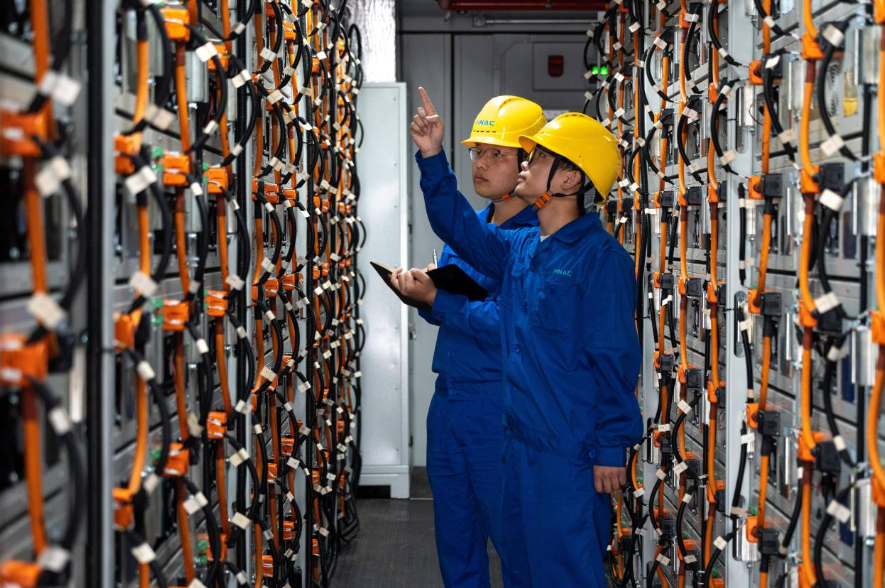
Technicians check equipment at an energy storage station in Yongzhou, central China's Hunan province.
“These facilities are designed to work with photovoltaic power generation. The electricity produced during the day is temporarily stored here and then released at night when demand peaks, thereby maximizing efficiency and preventing waste,” said Cui Guangze, general manager of a new energy company under China Huaneng Group, which manages the project.
This process demonstrates the role of large-scale battery storage systems: charging during off-peak hours and discharging during peak times to stabilize supply. Such systems are now being deployed across an expanding range of applications.
According to the National Energy Administration (NEA), China’s installed capacity of new energy storage projects reached 73.76 million kilowatts by the end of 2024, an increase of over 130 percent compared with 2023. As of June 2025, capacity climbed further to 94.91 million kW/222 million kWh, up nearly 29 percent from the end of 2024. China now accounts for more than 40 percent of global new energy patents, underscoring its leading position in technology and equipment.
Energy storage has become a critical element in building a new power system. With solar and wind generation subject to weather variations, storage units act as “power banks” and “dispatching stations,” saving excess energy and releasing it during cloudy days or peak hours, keeping households supplied and industries running.
“The importance of new-type energy storage is becoming increasingly evident. In 2024, we observed a significant improvement in utilization rates compared to 2023. In provincial-level regions such as Zhejiang, Jiangsu, Chongqing, and Xinjiang, annual equivalent utilization hours exceeded 1,000, making storage a key driver of renewable energy integration and consumption,” said Bian Guangqi, deputy director of the NEA’s energy saving and technology equipment department.
This summer, when electricity demand repeatedly set new records—36 times across 16 provincial grids—the NEA organized a centralized dispatch trial using new-type energy storage to manage peak loads. Within the State Grid’s service area, the maximum dispatchable storage power reached 64.23 GW, with real-time discharge peaking at 44.53 GW, 55.7 percent higher than last year. The peak-shaving capacity equaled the output of three Three Gorges Dams, sustaining supply for an average of 2.4 hours during evening demand surges.
In Suzhou, Anhui province, the country’s largest “coal-to-power plus molten salt” project completed a 168-hour trial run and officially began operation. The system, China’s first gigawatt-hour-level molten salt thermal storage integrated with a coal-fired unit, functions like a “thermal battery.” During off-peak periods, steam heats molten salt to store energy, which is later released to balance power and heating needs.
China’s energy storage sector is diversifying with multiple technological pathways. In 2024, the NEA approved 56 pilot projects covering more than a dozen approaches. “China’s advances in new-type energy storage are moving from isolated breakthroughs to a more systematic framework,” said Rao Hong, chief scientist at China Southern Power Grid.
Rapid progress is being made in lithium batteries, compressed-air storage, flow batteries, and flywheels. At the same time, semi-solid and all-solid-state batteries and hydrogen storage are advancing to provide multi-timescale flexibility, higher safety, and resilience in extreme conditions.