
Quantum mechanics describes the unconventional properties of subatomic particles, such as their ability to exist in superpositions of multiple states (as popularized by Schrödinger's cat analogy) and to pass through barriers—a phenomenon known as quantum tunneling.
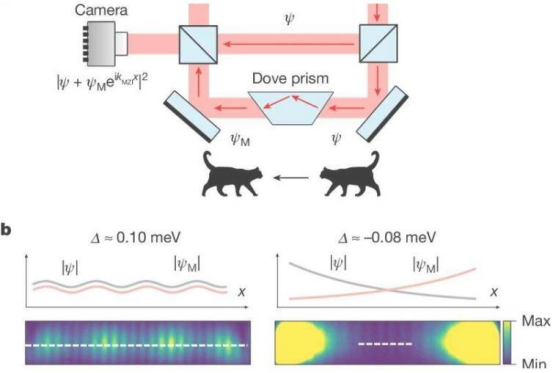
In a report published in Nature, a group of researchers tested a unique aspect of Bohmian mechanics, an alternative interpretation of quantum theory. This twist on classical quantum theory predicts that tunneling quantum particles would remain "stationary" inside an infinitely long barrier. Consequently, the time they spend inside the barrier (known as dwell time) would be infinite.
In the standard "Copenhagen" interpretation of quantum physics, photons and other subatomic particles exist as probability waves with no definite position until observed. Upon observation, the particle's wave function collapses into a discrete particle with a definite location, as famously demonstrated by the double-slit experiment.
The alternative Bohmian interpretation maintains that particles remain point-like objects. In this model, a particle's position is determined by some unmeasured "hidden" variables, while their trajectories are guided by pilot waves, thereby exhibiting wave-particle duality.
Both interpretations make many identical predictions, but they differ significantly in how they describe the fundamental nature of particles.
To test Bohmian mechanics' unique prediction—that photons could effectively freeze in time while traversing an infinitely long barrier—the researchers designed an experiment that simulates an infinitely long barrier for photons.
The setup consisted of a pair of specially crafted mirrors sandwiched together. The lower mirror was etched with nanoscale ramps and a pair of parallel waveguides. By shining a laser on the ramps, the researchers could generate photons and control their momentum.
As the photons propagate along the waveguide and tunnel into the barrier, they also tunnel into the secondary waveguide, bouncing back and forth between the two at a constant rate. This allowed the research team to calculate their speed.
By combining this temporal element with measurements of the photon decay rate inside the barrier, the researchers were able to calculate the dwell time and found it to be finite.
The researchers wrote: "Our findings contribute to the ongoing debate on tunneling time and can be regarded as a test of Bohmian trajectories in quantum mechanics. Regarding the latter, we find that the measured energy-velocity relationship is inconsistent with the particle dynamics assumed by the guiding equation in Bohmian mechanics."
This result challenges Bohm's prediction but does not rule it out. Since the researchers' experiment was a simulation reliant on various assumptions, its conclusions are not definitive and may themselves be contested.