
A research team from the Cavendish Laboratory at the University of Cambridge in the UK has published its latest results in the journal Light: Science & Applications, developing a terahertz modulation technology with record-breaking performance. This breakthrough provides key technical support for cutting-edge applications such as 6G communications and terahertz imaging.
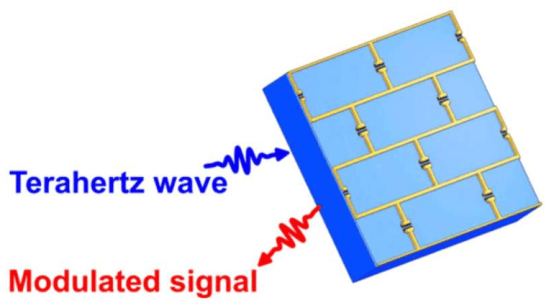
The research team, led by Dr. Wladislaw Michailow, innovatively used graphene to construct nanoscale tunable capacitors, achieving highly efficient control of terahertz waves. Michailow stated: “We are not suppressing resonance, but precisely controlling the characteristics of terahertz waves like playing a flute.” The technology achieves a modulation depth exceeding 99.99% and operates at a frequency of 30 MHz, far surpassing existing solutions.
The experiment employed a metamaterial structure, embedding graphene patches less than 1 micrometer wide into resonators. Dr. Ruqiao Xia noted: “This design achieves a four-order-of-magnitude improvement in modulation depth while maintaining high speed.” The research team also further optimized device performance through reflective structures.
Professor David Ritchie, head of the Semiconductor Physics Group, said: “This achievement is an important step toward developing terahertz communication systems beyond 5G.” The technology can also be applied in areas such as security screening and medical imaging. The research team is currently collaborating with multiple universities to advance the practical application of the technology.