
According to results published in Nature on August 20, the device named “Thunderbird Reactor” has successfully increased the deuterium fusion rate using a breakthrough electrochemical method. The experiment demonstrates how a particle accelerator can influence nuclear reaction rates at much higher energy levels through low-energy electrochemical processes. This progress paves the way for broader and more efficient research into driving nuclear fusion.
Nuclear fusion—the process that powers the Sun—involves two light atomic nuclei combining to form a heavier nucleus while releasing energy. It is considered a potential source of clean energy, but current fusion reactors still cannot produce enough fusion events to generate more energy than they consume.
One factor controlling fusion rate is fuel density: higher density increases the probability of particle collisions and thus the likelihood of fusion. One fusion approach compresses nuclear fuel (typically deuterium plasma, a heavy isotope of hydrogen) to critical conditions for fusion using magnetic fields, temperature, and pressure—but this technology remains under development.
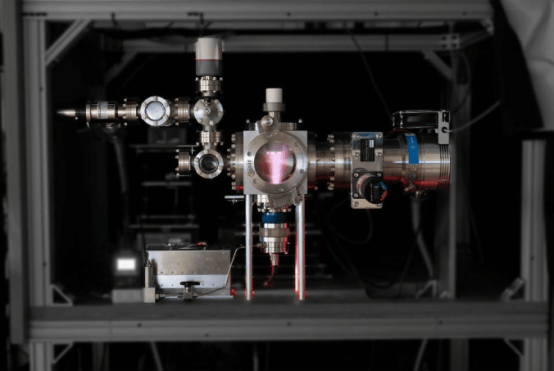
In this study, a research team from the University of British Columbia in Canada explored a completely new pathway to enhance deuterium fusion rates. They designed a tabletop particle accelerator called the “Thunderbird Reactor” based on electrochemical principles. The device bombards a palladium target with a deuterium ion beam. As the concentration of deuterium implanted in the palladium increases, the fusion rate between implanted deuterium and newly entering deuterium from the beam also rises until a steady state is reached.
The palladium target is also connected to an electrochemical cell. When the cell is activated, more deuterium is injected into the target, further increasing the fusion rate. On average, the fusion rate increased by 15% compared to cases without electrochemical loading. The research team reported that the “Thunderbird Reactor” currently produces about one-billionth of a watt of power for every 15 watts of input energy.
In a simultaneously published News & Views article, experts noted that efficient nuclear fusion remains a major challenge and this method is still far from achieving energy output greater than input. Nevertheless, “using electrochemical methods to increase nuclear fusion rates is a major achievement,” because “with advances spanning nuclear physics, chemistry, and materials science, scientists are paving the way for broader research into driving low-energy nuclear fusion using accessible tabletop reactors.”