
The Galactic Habitable Zone (GHZ)—the region of the Milky Way hypothesized to be capable of supporting the evolution of complex life—can provide scientists with valuable guidance in identifying the right stars likely to host habitable planets.
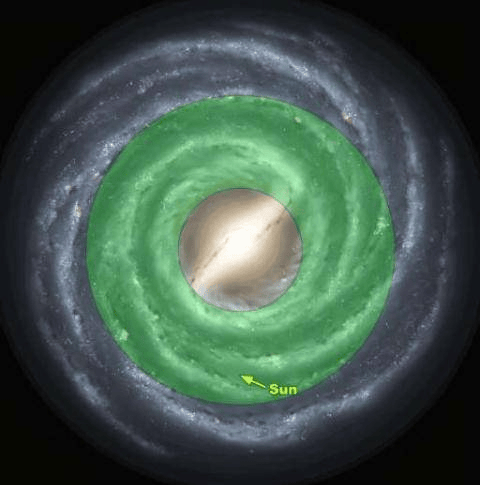
This is exactly the question a recent study, accepted for publication in Astronomy & Astrophysics, aims to address. Conducted by an international research team, the study investigates the connection between stellar migration (commonly referred to as stellar migration) and the search for habitable planets within the Milky Way. The findings are expected to help scientists better understand the astrophysical parameters involved in searching for habitable worlds beyond Earth and life as we know it. The results have been posted on the arXiv preprint server.
In this study, researchers used a series of computer models to simulate how stellar migration affects the location and parameters of the GHZ. These models included scenarios with and without stellar migration to determine the statistical probability of terrestrial (rocky) planet formation around stars throughout the galaxy. The team also employed a chemical evolution model to characterize the formation and evolution of our galaxy, particularly its thickness.
Ultimately, the researchers found that stellar migration influences the formation of habitable planets in the outer regions of the galaxy. This is because stellar migration causes the redistribution of stars across the entire galaxy. The research team estimates that stellar migration increases the likelihood of stars forming habitable planets by a factor of five compared to scenarios without migration. Additionally, the team discovered that gas giant planets may affect the formation of terrestrial planets in the inner regions of the galaxy.
The paper concludes: “Compared with existing analyses in the literature, this study significantly expands the exploration of the parameter space defining the Galactic Habitable Zone. Our findings are particularly important for upcoming space missions, such as the European Space Agency’s PLAnetary Transits and Oscillations of stars (PLATO), the ESA’s Ariel space mission, and the Large Interferometer For Exoplanets (LIFE). These missions will provide unprecedented data on planetary properties, orbital architectures, and atmospheric compositions.”
The concept of the GHZ builds on the long-established idea of the stellar habitable zone (HZ)—the specific distance from a star at which a planet can maintain liquid water on its surface. The GHZ concept was first proposed in the 1950s. Like all scientific concepts, the GHZ has evolved since its introduction in the 1980s, but its core idea remains that the zone is composed of heavier elements (such as iron, silicon, and oxygen) that form rocky, Earth-like planets.
As the study points out, there is still debate about the exact size of the GHZ, but the scientific consensus is that the GHZ does not exist in the center of the Milky Way due to the abundance of supernovae and other energetic events in that region, which would limit the formation of habitable planets.
The study highlights that the European Space Agency (ESA) is preparing several missions aimed at expanding our understanding of how and where to search for life beyond Earth. For example, the PLATO mission, scheduled for launch in December 2026, will scan one million stars to observe and identify exoplanets transiting in front of their host stars—one of the most common methods used to discover exoplanets to date.
The Ariel mission, planned for launch in 2029, aims to observe at least 1,000 confirmed exoplanets to further understand their chemical and thermal compositions. The LIFE mission, initiated in 2017, is designed to study the atmospheres of terrestrial exoplanets in order to identify potential signs of life, known as “biosignatures.”