
Using seawater and sunlight to produce green hydrogen and high-purity water—transforming two abundant, low-cost resources into high-value products—how is this achieved?
Recently, a team led by Assistant Professor Zhang Lenan from Cornell University, in collaboration with researchers from MIT, Lehigh University, Johns Hopkins University, and other institutions, has developed an efficient, low-cost solar-driven seawater hydrogen production technology.
The recent innovative technology achieves efficient full-spectrum utilization of solar energy through a cleverly designed photothermal response-static water coupling device—not only fully utilizing the photovoltaic effect of solar energy but also effectively harnessing its photothermal effect.
Experimental data shows that under standard solar irradiation (1kW/m²), the solar-to-hydrogen conversion efficiency reaches 12.6%, with hydrogen production of 35.9L/m²/h. At the same time, it utilizes waste heat from photovoltaic panels to produce 1.2L of clean water per square meter.
Techno-economic analysis indicates significant advantages of the system: after 3 years of operation, the green hydrogen production cost can reach $5 per kilogram; after 15 years, it can further drop to $1 per kilogram. This technology demonstrates strong commercialization potential and provides an economically viable pathway for future large-scale sustainable green hydrogen production.
The related paper, titled “Over 12% Efficiency Solar-Powered Green Hydrogen Production from Seawater,” was recently published in Energy & Environmental Science [1]. Lehigh University Assistant Professor Wang Xuanjie is the first author, with Cornell University Assistant Professor Zhang Lenan, Toronto State University Assistant Professor Liu Xinyue, and Johns Hopkins University Assistant Professor Liu Ya Yuan as co-corresponding authors.
Hydrogen energy, as a renewable energy source with promising development prospects, has unique advantages in decarbonization transformation, low-carbon energy storage, and clean energy supply. Among them, green hydrogen produced from intermittent renewable energy sources via water electrolysis features near-zero carbon emissions across its full lifecycle and is widely regarded as a core component of the future energy system.
However, traditional green hydrogen production faces a critical bottleneck of massive water resource consumption. Theoretical calculations show that producing 1kg of hydrogen in a continuous process requires at least 9kg of water, while actual industrial production often consumes 20–30kg.
More critically, the intermittent process requires ultra-pure water (with impurities and ion concentrations as low as micrograms per liter), and this additional purification treatment not only significantly increases production costs but also exacerbates resource allocation imbalances amid global water scarcity, contradicting the principles of sustainable development.
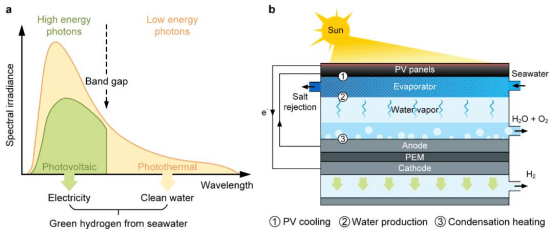
To address this series of challenges, the research team innovatively proposed a solar full-spectrum comprehensive utilization scheme. Traditional photovoltaic technology is limited by the narrow bandgap of semiconductor materials and can only utilize photons in specific wavelength bands of the solar spectrum (theoretical maximum conversion efficiency ≈30%, actual usually <20%), with the remaining energy lost as waste heat. This waste heat not only causes energy loss but also raises the temperature of photovoltaic modules, leading to efficiency degradation cycles.
The research team introduced solar interfacial evaporation technology to turn this “waste heat problem” into a “resource opportunity.” They constructed a special water film evaporation layer on the surface of photovoltaic modules, using waste heat to drive water evaporation and obtain high-purity water through a condensation system.
This innovative design achieves three-fold effects: first, the cooling effect reduces the photovoltaic module temperature by more than 15°C, significantly improving photoelectric conversion efficiency; second, it converts wasted heat into effective energy for desalination; third, a large amount of high-purity water can be directly extracted and utilized in the electrolyzer.
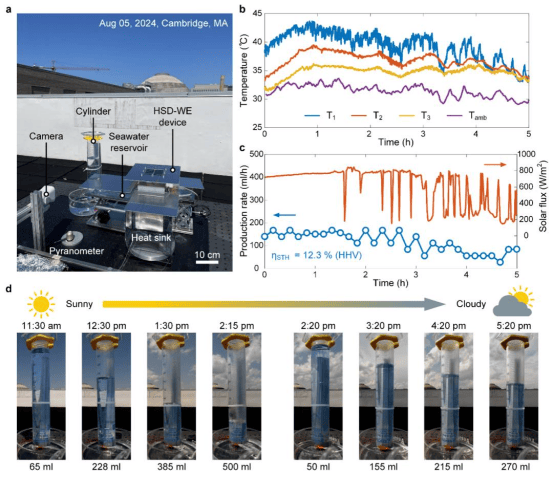
To simultaneously maximize hydrogen production and water output, the team implemented a series of measures, including system design, device optimization, and the introduction of innovative components.
Specifically for hydrogen production latent heat, they developed a unique thermal management module that converts waste heat from photovoltaic modules into latent heat through steam condensation and directs it to the electrolyzer.
This design cleverly leverages the opposing temperature response characteristics of photovoltaic modules (efficiency decreases with temperature rise) and steady-state electrolyzers (efficiency increases with temperature rise), constructing a cascaded utilization closed-loop system. Experimental data show that the waste heat steam conversion efficiency of the system approaches 90%, achieving maximum utilization of waste heat.
In seawater desalination, the team’s previously developed photothermal interfacial evaporation technology, through localized high-efficiency thermal management, concentrates thermal energy on the evaporation surface, significantly improving evaporation efficiency. Through this macro-system coupling and synergistic optimization of components, the final realization of solar-driven simultaneous hydrogen production and freshwater co-production from seawater was achieved.
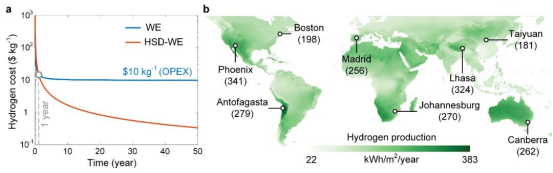
According to relevant forecasts, the world is currently facing a massive gap of about 500 million tons of green hydrogen resources. Behind this lies the demand for billions of tons of ultra-pure water, which is almost impossible to meet amid global water scarcity.
However, theoretical calculations in this study indicate that deploying this innovative technology would require only 0.06% of land area to directly utilize seawater and solar resources to fill this gap.
Zhang Lenan explained to DeepTech: “The deployment model of this technology is similar to solar photovoltaics. If this hydrogen production factory can be scaled up like building solar farms, it can achieve the oxygen output required for carbon neutrality goals with relatively small land occupation—this is mainly due to the widespread and uniform distribution of solar resources.”
The breakthrough significance of this technology is also reflected in water resource utilization. Traditional water electrolysis for hydrogen production not only consumes large amounts of electricity but is also dependent on the supply of high-purity water. This new technology completely changes this supply chain, allowing the hydrogen production process to directly use various non-pure water sources such as seawater, river water, groundwater, and even wastewater, which is revolutionary for achieving large-scale industrial production in the future.
Zhang Lenan further pointed out that the core reason for the current insufficient supply in the green hydrogen market—apart from high costs—is its dependence on high-purity water. This technology, by directly utilizing various non-pure water sources, not only significantly reduces production costs but, more importantly, resolves the resource bottleneck for large-scale production.
In terms of technical development path, the team adopted a step-by-step strategy. The laboratory stage focused primarily on performance optimization, aiming to improve hydrogen and freshwater yield per unit of solar input. Notably, the team’s earlier seawater desalination technology set a world record for solar desalination of high-salinity seawater and was selected as one of TIME magazine’s “Best Inventions of the Year.”
With these technical accumulations, the researchers innovatively combined water desalination with solar photovoltaic technology in an efficient and organic manner, achieving significant improvements in system performance. As the technology continues to mature, the team is now working to scale up laboratory prototypes into larger-scale demonstration systems and plans to carry out demonstration projects.
With these technical accumulations, the researchers innovatively combined water desalination with solar photovoltaic technology in an efficient and organic manner, achieving significant improvements in system performance. As the technology continues to mature, the team is now working to scale up laboratory prototypes into larger-scale demonstration systems and plans to carry out demonstration projects.
This model is particularly suitable for global energy applications, avoiding the complexity of large-scale grid scheduling while solving the intermittency problem of renewable energy power supply. The research team stated that after technical scale-up validation, they will focus on demonstrating the practical application effects of this technology in global energy systems, further providing new technical routes to promote energy transformation.