
The Manufacturing Demonstration Facility (MDF) at the U.S. Department of Energy’s Oak Ridge National Laboratory, in collaboration with Kairos Power and Barnard Construction Company, has taken a bold step in nuclear infrastructure construction by successfully developing and validating large-scale 3D-printed polymer composite forms for casting complex, high-precision concrete structures—marking a new milestone for the future of nuclear energy in the United States.
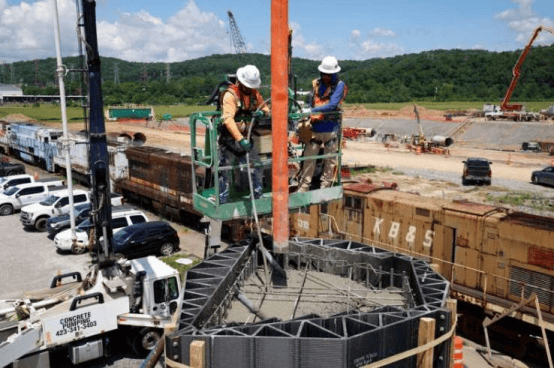
Traditional methods for producing these concrete structures are technically challenging and extremely costly. The newly developed 3D-printed forms are now being applied in the construction of Kairos Power’s Hermes low-power demonstration reactor at its Oak Ridge campus. Among them, the 3D-printed model for the Janus shielding demonstration serves as a prototype for certain components of the Hermes reactor facility. Each component measures approximately 10 feet × 10 feet, with three stacked units forming a columnar structure. Some of the models were exhibited at the East Tennessee Economic Council’s Nuclear Opportunities Workshop.
The use of 3D-printed forms or molds enables innovative structural designs and represents a major leap forward in infrastructure construction. Kairos Power plans to scale up this technology for larger commercial power plants in the future. The composite forms significantly shorten production time, allowing “on-site casting” of complex structural components to be completed in just days—compared to weeks with traditional steel or wooden forms, which are costly, low-precision, and time-consuming. This shift brings a major advancement to nuclear power construction methods.
Ryan Dehoff, Director of the Manufacturing Demonstration Facility, stated that combining the capabilities of a national laboratory with MDF’s mission to turn bold ideas into viable solutions accelerates the development of new commercial nuclear energy technologies. Over the past decade, MDF has led numerous pioneering initiatives and is now addressing the challenges of modernizing nuclear energy.
Edward Blandford, Co-Founder and Chief Technology Officer of Kairos Power, noted that the company has collaborated with MDF since its inception. MDF is fast-acting and creatively minded, delivering transformative results. When exploring prefabricated concrete system options, Kairos Power received recommendations from commercial partners to engage with MDF. MDF’s collaborative approach supports Kairos Power’s use of rapid learning cycles to accelerate technology deployment—by first building and testing tower column molds to refine methods and reduce risk.
Kairos Power’s Janus columns demonstrate innovative design elements of the Hermes biological shield—a thick concrete structure built around the nuclear reactor to absorb radiation and protect workers.
The project is supported by multiple industry partners, including Airtech, TruDesign, Additive Engineering Solutions, and Haddy, collectively building a new supply chain empowered by additive manufacturing technologies for nuclear infrastructure. Barnard Construction Company is responsible for implementing and adjusting the 3D-printed forms, providing real-time feedback and integrating design changes to improve constructability and enable rapid deployment. The leader of ORNL’s Composites Innovation Team stated that the forms must withstand enormous pressure from heavy concrete, requiring not only geometric precision but also structural integrity under high stress—pushing the limits of additive manufacturing in structural applications.
The project originated from the multi-year SM2ART Moonshot program, led by MDF and the University of Maine, leveraging ORNL’s strengths in materials science, supercomputing, and artificial intelligence, as well as the University of Maine’s complementary expertise in large-scale 3D printing. The initiative holds national significance: the Knoxville–Oak Ridge region is home to the world’s largest concentration of nuclear power companies. The Hermes reactor is the first advanced reactor to receive a construction permit from the U.S. Nuclear Regulatory Commission, laying the foundation for Kairos Power’s future commercial plants and next-generation reactors.
Over the next 18 months, the SM2ART Moonshot project will continue to support Kairos Power’s construction efforts, expanding to full-scale production of radiation shielding and reactor building enclosures, while integrating smart manufacturing technologies and more. Partners aim to use printable bio-composite feedstocks to reduce material costs by 75%. By demonstrating that nuclear construction can adopt new manufacturing practices, the project provides a compelling vision for lowering costs and timelines for future reactors.