
A research team from Waseda University in Japan recently published innovative results in the journal Journal of Materials Chemistry, successfully developing a new synthesis method that enables precise control over the composition, pore structure, and crystal size of single-crystal nanoporous metal oxides. This breakthrough opens new pathways for applications in catalysts, energy materials, and other fields.
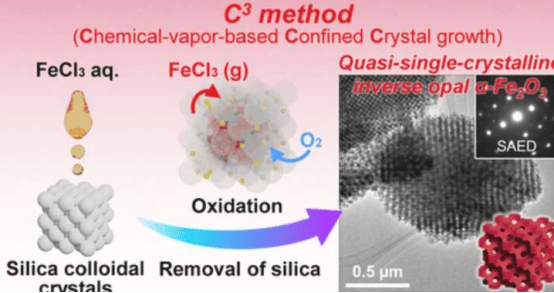
The research team employed a confined crystal growth method based on chemical vapor phase (C³), using iron oxide (α-Fe₂O₃) as the research subject. By controlling the precursor solution and template conditions, they successfully prepared three-dimensionally ordered nanoporous quasi-single-crystal materials. Team leader Assistant Professor Takamichi Matsuno stated: “Iron is one of the most abundant metals on Earth, and iron oxide has a wide range of applications, including catalysts, electrodes, magnetic devices, and sensors.”
During the experiments, the researchers impregnated a FeCl₃ precursor solution into a silica nanosphere template, followed by drying and heating treatment, and then dissolving the template to obtain the target product. Matsuno explained: “By heating iron chloride within the template, vapor-phase transport promotes nucleation and crystal growth of α-Fe₂O₃ via FeOCl. As a result, we obtained nanoporous α-Fe₂O₃ with larger and more uniform crystal grain sizes compared to those prepared using the previously reported Fe(NO₃)₃ hydrate precursor.”
Compared to traditional methods, the materials produced by this technique exhibit superior thermal stability and catalytic activity. In photo-Fenton reaction tests, the novel nanoporous material demonstrated significantly enhanced catalytic performance. This achievement not only resolves key challenges in the synthesis of single-crystal nanoporous materials but also provides new ideas for developing high-performance functional materials.