
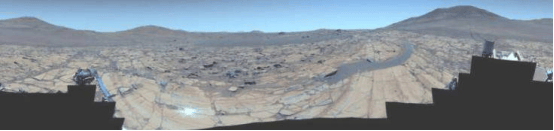
NASA's Perseverance Mars rover imaging team took advantage of the Red Planet's clear skies to capture one of the clearest panoramic views of its mission to date. The mosaic image is composed of 96 individual photos taken at a location the science team calls "Falbreen." The image shows a rock that appears perched atop a dune, a boundary between two geologic units, and hills as far as 40 miles (65 kilometers) away. The enhanced-color version reveals an unusually clear Martian sky with a deceptively blue tint, while the natural-color version shows the subtle reddish hues.
"We are aggressively pursuing human space exploration, ultimately sending astronauts to the Moon," said acting NASA Administrator Sean Duffy. "Stunning vistas like Falbreen, captured by our Perseverance Mars rover, are just the tip of the iceberg of what we will soon see with our own eyes. NASA's pioneering missions, beginning with the Artemis program, will drive our unstoppable journey to Mars, bringing human space exploration to the surface of the Red Planet. NASA is getting bolder and stronger."
The images were taken by the rover's Mastcam-Z instrument on May 26, 2025 (the 1,516th Martian day, or sol, of the mission). Perseverance began its mission at the bottom of Jezero Crater in February 2021. Late last year, the rover reached the top of the crater rim.
"The relatively dust-free sky allowed us to see the surrounding terrain with exceptional clarity," said Jim Bell, principal investigator for Mastcam-Z at Arizona State University in Tempe. "In this particular mosaic, we enhanced the color contrast to highlight the differences between the terrain and the sky."
Pumice
One detail that caught the science team's attention is a large rock near the center-right of the mosaic that appears to sit atop a dark, crescent-shaped sand ripple about 4.4 meters from the rover. Geologists call this type of rock "pumice" because it was likely formed elsewhere and then transported to its current location. Whether it arrived via landslide, water flow, or wind is unclear, but the science team suspects it was in place before the sand ripple formed.
The bright white circular patch near the center-left and bottom of the image is an abrasion patch—the 43rd rock abraded by Perseverance since landing on Mars. The shallow patch, about 5 centimeters (2 inches) wide, was created by the rover's drill, allowing the science team to peer beneath the weathered, dust-covered surface of the rock before deciding whether to drill a core sample and store it in one of the mission's titanium sample tubes.
The rover performed the abrasion on May 22 and conducted close-up science with its arm-mounted instruments two days later (detailed analysis of Martian rocks and soil). The science team is interested in Falbreen because it sits in what may be one of the oldest terrains Perseverance has explored—potentially even older than Jezero Crater itself.
The rover's tracks leading to the site are visible along the right edge of the mosaic. About 300 feet (90 meters) farther, they turn left and disappear toward a previous geologic site the science team calls "Kenmore."
Across the middle of the mosaic, slightly above halfway from one side to the other, is a transition from lighter to darker rocks. This is a contact between two geologic units. The flat, light-colored rocks closer to the rover are rich in olivine minerals, while the darker rocks farther away are believed to be older clay-bearing rocks.