
A research team affiliated with the Ulsan National Institute of Science and Technology (UNIST) in South Korea has successfully demonstrated the experimental creation of collective quantum entanglement based on dark states — a theoretical model that was previously unrealizable. The research results were published online in Nature Communications.
Unlike bright states, dark states exhibit strong resistance to external disturbances and significantly prolonged lifetimes, making them promising candidates for next-generation quantum technologies such as quantum memories and ultrasensitive sensors.
The team, led by Professor Je-Hyung Kim from the Department of Physics at UNIST, in collaboration with Dr. Changhyoup Lee from the Korea Research Institute of Standards and Science (KRISS) and Dr. Jin Dong Song from the Korea Institute of Science and Technology (KIST), successfully achieved controllable induction of collective entanglement based on dark states. Notably, the lifetime of this entanglement is approximately 600 times longer than that of conventional bright states.
Quantum entanglement among multiple nearly indistinguishable particles typically manifests as either bright states or dark states. Dark states are characterized by near-complete suppression of emitted light, allowing entanglement to persist for much longer periods.
Although this protective property holds enormous potential for quantum information storage and transmission, creating and maintaining dark states has long been a major experimental challenge.
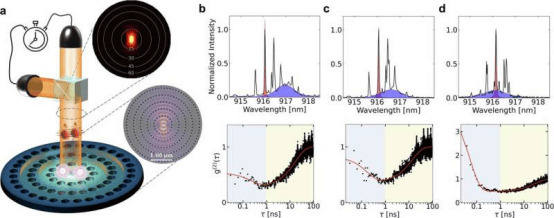
The researchers overcame these obstacles by using a nanocavity with carefully tuned loss rates to balance the coupling strength between quantum dots and the cavity's dissipation.
Dr. KyuYoung Kim, the first author of the study, explained: “When cavity loss is too high, the quantum dots act independently with no mutual influence. Conversely, when the coupling is sufficiently strong, a collective entangled state forms that resists external interference.”
In the experiment, the team observed that entanglement in the dark state could persist for up to 36 nanoseconds — approximately 600 times longer than the typical 62 picoseconds of bright states. They also detected phenomena such as non-classical photon bunching, providing direct evidence of dark-state formation.
Although such states generally suppress photon emission, under specific conditions the entangled quantum dots emit photons simultaneously, exhibiting the unique properties of dark states.
Professor Kim commented: “The experimental realization of dark-state entanglement — once purely theoretical — demonstrates that by carefully engineering loss, we can maintain quantum correlations for extended periods. This opens new pathways for quantum information storage, high-precision sensors, and energy-harvesting technologies based on quantum principles.”