
A new international study focuses on the field of artificial intelligence memory, introducing a novel AI memory architecture inspired by geometry called the “curved neural network.” By altering the “space” in which AI “thinks,” the research achieves explosive memory recall—similar to the human brain’s sudden “aha” moments of insight—opening new pathways for brain-inspired computing, neuroscience, and next-generation robotics.
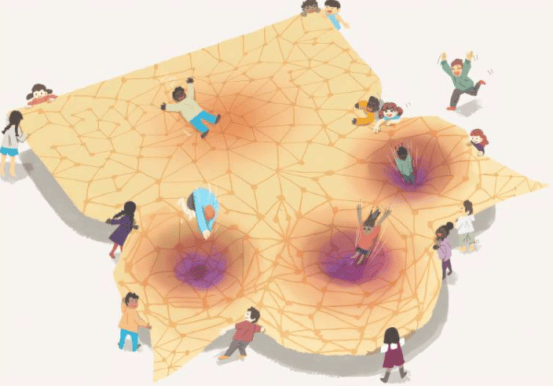
A research team composed of the Basque Center for Applied Mathematics, Araya Inc., the University of Sussex, and Kyoto University has developed this curved neural network, a new type of artificial intelligence model. The research results were published in Nature Communications, demonstrating how surface geometry enables AI to perform more complex and realistic memory processes without additional computational burden. Traditional AI systems rely on simple connections, whereas the human brain features multi-directional interactions; the team introduced curved geometry precisely to address this difference. The curved neural network possesses three key characteristics: explosive memory recall, allowing the system to effortlessly jump to stored memories; self-regulating intelligence, enabling the AI to automatically adjust its “focus” during recall and accelerate response speed; and fewer errors, where a single tuning parameter can balance memory capacity and accuracy.
Pablo A. Morales from Araya Inc. stated: “These properties are not hard-coded but emerge naturally from the curved geometry of the model.” This discovery is expected to make AI systems more adaptive, efficient, and interpretable—a major leap forward compared to the current powerful yet opaque “black-box” models. Fernando E. Rosas from the University of Sussex remarked: “This demonstrates how geometry and physics can guide progress in both natural and artificial systems, opening new ways to think about how brains and machines efficiently store and retrieve information.” Associate Professor Hideaki Shimazaki from Kyoto University noted that the initially simple idea—using curved geometry in neural networks—evolved into a deep collaboration, and this discovery will contribute to the future of artificial intelligence.