
A research team at Yale University has recently published their findings in the journal Cell, successfully developing novel RNA editing tools R-IscB and R-Cas9. This technology is based on the RNA-targeting activity discovered within the CRISPR-Cas9 system, offering a potentially safer alternative for gene therapy.
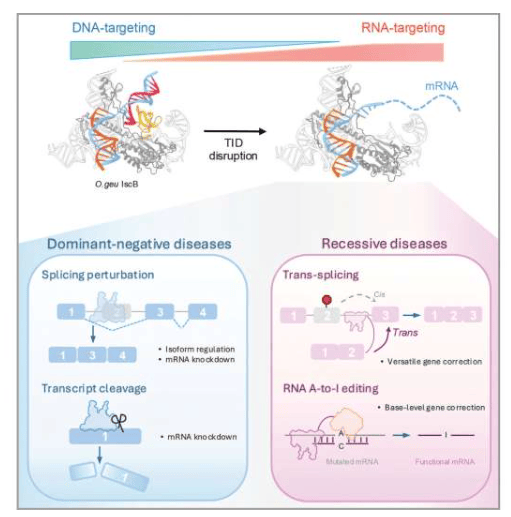
The research team discovered that powerful RNA-targeting activity is hidden within traditional CRISPR gene editing tools. Senior author, Yale School of Medicine Professor Ai-Long Ke, stated: "The solution is surprisingly simple. We uncovered the RNA-targeting activity hidden in CRISPR tools and their associated enzyme IscB, and unleashed its latent power to target RNA."
Unlike direct DNA editing, RNA editing does not cause permanent genetic changes, thus offering greater safety. First author Chengtao Xu, PhD, noted: "It was much more challenging to arrive at the same idea from Cas9 because its structure is far more complex than IscB. Nature has left us many treasures; revealing them is challenging but fascinating."
The researchers describe the new tools as a “Swiss Army knife for RNA editing,” capable of precisely interfering with mRNA function, cleaving target mRNA, or correcting coding errors. Professor Ke emphasized: "In essence, we now have a way to perform virtually any type of genetic surgery at the RNA level—this is a big deal."
Currently, the research team plans to test these tools in the laboratory for their potential in treating rare genetic diseases and promoting wound healing. Dr. Xu stated: "We are very excited to see how far this approach can develop alongside other similar tools." Professor Ke specifically highlighted: "We are particularly excited about the trans-splicing reaction we performed with R-IscB, as it holds the potential to correct any type of genetic mutation at the RNA level."