
Lithium-ion batteries (LIBs) are widely used in consumer electronics, electric vehicles, and renewable energy systems. Their efficient recycling and reuse are of great significance for sustainable development. Recently, a research team led by Professor Dan Zeng from the Department of Civil and Environmental Engineering at the Hong Kong University of Science and Technology achieved a major breakthrough by revealing an atomic-scale mechanism that has previously gone unrecognized as a barrier to efficient lithium-ion battery recycling. The related results were published in Advanced Science.
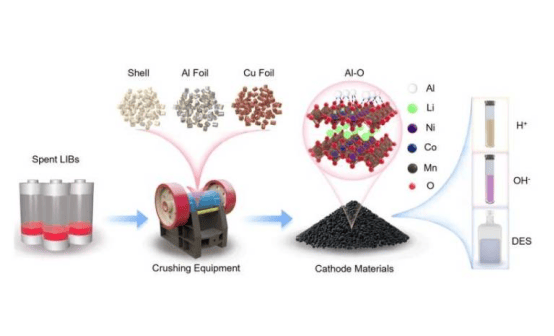
For a long time, the presence of aluminum in waste lithium-ion batteries has been regarded as a minor operational interference or small issue. However, this study discovered that it is a serious mechanical interference factor hindering recycling. Using advanced characterization and first-principles modeling, the research group found that aluminum impurities generated during the mechanical disassembly of lithium-ion batteries penetrate into the NCM (nickel-cobalt-manganese) cathode crystals, reshaping the internal chemical properties of the cathode. Aluminum atoms selectively replace cobalt, forming ultra-stable aluminum-oxygen bonds that anchor lattice oxygen and inhibit the release of key metals such as nickel, cobalt, and manganese during leaching—particularly in the acidic solvent systems commonly used in hydrometallurgy—making metal extraction more difficult.
In addition, the study shows that the type of solvent used in the recycling process affects the behavior of aluminum, exhibiting solvent-dependent effects. For example, aluminum slows metal release in formic acid, enhances metal release in ammonia, and shows mixed results in deep eutectic solvents, highlighting the need for precise, chemistry-driven process design.
Professor Dan Zeng stated that even trace amounts of aluminum contamination can fundamentally alter the behavior of NCM materials in recycling systems, requiring a paradigm shift in the management of impurity pathways during inter-battery recycling.
These findings provide a clear roadmap for overcoming two major bottlenecks in lithium-ion battery recycling: impurity interference and energy intensity. By combining precise impurity analysis with intelligent disassembly strategies, the research offers tools for industry and policymakers to scale up sustainable battery recycling systems. Professor Zeng emphasized that this work not only solves problems but also redefines efficient, climate-compliant battery recycling methods. These innovative results align with the United Nations Sustainable Development Goals, particularly in responsible consumption and production, affordable and clean energy, and climate action.