
As traditional communication technologies face security bottlenecks due to classical physics limitations, quantum communication—leveraging the quantum properties of light and single-photon information carriers—is emerging as a key direction for advancing secure communication systems. A research team from Kyoto University has published their latest results in Science Advances, demonstrating significant enhancement in single-photon emission efficiency by introducing defects into two-dimensional semiconductors and applying an external magnetic field, opening a new pathway for developing quantum information devices.
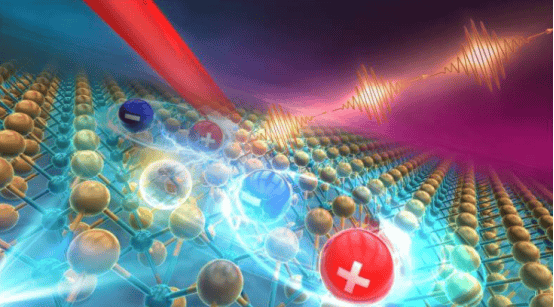
The study focuses on monolayer tungsten diselenide (WSe₂), a two-dimensional semiconductor only a few atoms thick. The team introduced specific defects into the material through heat treatment, binding excitons (electron-hole pairs) and enabling emission of only single photons. In experiments conducted at -265°C, the researchers measured luminescence properties and found that applying a weak magnetic field dramatically increased emission intensity. Further photon correlation measurements confirmed antibunching, proving that photons are emitted one at a time, and magnetic field control can optimize this process. "The role of the magnetic field not only validates the feasibility of two-dimensional semiconductors as single-photon sources but also reveals their potential for efficiency enhancement through external control," said team leader Kazunari Matsuda.
This achievement addresses the core issues of efficiency and controllability in single-photon sources for quantum communication. The study shows that two-dimensional semiconductors, under magnetic field modulation, can simultaneously achieve precise control of photon emission and performance optimization, providing an innovative solution for building secure and compact quantum information devices. The research team plans to further explore the effects of different magnetic field strengths and material structures on emission characteristics to drive the technology toward practical applications.