
A new study published in the journal npj Robotics has successfully overcome the challenge of small quadrotor aircraft flying in narrow air ducts, opening up entirely new application paths for industrial inspection and public safety fields. The research was led by a team of researchers from the French National Institute for Research in Digital Science and Technology (Inria), the French National Centre for Scientific Research (CNRS), the University of Lorraine, and Aix-Marseille University.
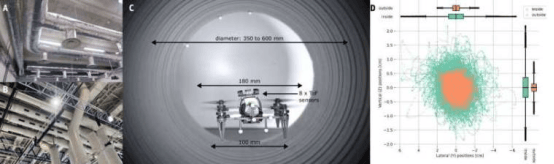
In modern buildings and underground pipe networks, ventilation ducts are widely distributed, but inspecting and maintaining them is extremely difficult. Ventilation ducts are narrow in size and cannot bear the weight of the human body, making it hard to carry out necessary intervention work to ensure the normal operation of air quality, heating, and air conditioning systems.
Small quadrotor drones, with their ability to fly both horizontally and vertically, have become a potential solution for exploring air ducts. However, when flying inside air ducts, they generate circulating airflow, causing the drone to become unstable. In environments with limited fault-tolerant space, this triggers severe turbulence, limiting its practical application.
To solve the above problems, the research team first deeply investigated the impact of the drone's position in the air duct on air circulation. With the help of a robotic arm and force/torque sensors, they accurately measured the forces at hundreds of positions and drew the first force "map". This map clearly presents complex aerodynamic patterns and can precisely identify the "unsafe" parts in circular ducts—areas where air recirculation pushes the drone toward the wall—as well as safer positions where the recirculation forces cancel each other out.
After determining the safe positions, how to enable the drone to accurately locate and maintain itself at the recommended points in a dark environment without visual cues became the key issue. The research team innovatively combined small lasers with artificial intelligence technology, using a neural network trained on motion capture data, so that the small drone can accurately perceive its own position and always stay in the position with the least turbulence, thereby achieving safer and more stable flight.
The results of this study bring new hope for the application of drones in industrial inspection and public safety fields. In the future, the research team plans to develop a more application-oriented prototype and equip it with practical payloads such as cameras, thermal imagers, or gas sensors to further expand its practical application scope in related fields.