
NASA and the European Space Agency have jointly released the latest images of the Red Spider Nebula captured by the James Webb Space Telescope. This Webb image, taken with the Near-Infrared Camera (NIRCam), clearly reveals for the first time the structural details of this planetary nebula located approximately 3,000 light-years from Earth, showcasing its unique distribution of gas and dust.
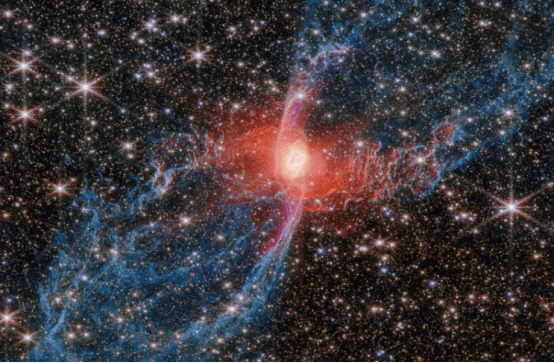
As a typical representative of the late evolutionary stage of Sun-like stars, the Red Spider Nebula consists of a hot central star surrounded by ionized gas clouds. Data from the James Webb Space Telescope show that the temperature of the central star is significantly higher than that of the surrounding region, and the ultraviolet radiation it emits causes the surrounding gas to glow visibly. While analyzing the Webb data, astronomers discovered that there may be an undetected companion star at the center of the nebula, providing new clues to explain its distinctive morphology.
Through observations with the James Webb Space Telescope's Near-Infrared Camera, researchers have, for the first time, fully mapped the spatial distribution of the nebula's extended lobe-like structures. These blue lobe structures, formed by glowing hydrogen molecules, span up to three light-years and form closed bubble shapes. The Webb data also captured jets of ionized iron in the central region of the nebula. These high-speed material flows interact with earlier ejected material, forming the ripple-like features observed in the images.
The latest observations from the James Webb Space Telescope provide important data for studying the late evolutionary stages of stars. The telescope's Near-Infrared Camera, with its high sensitivity to thermal dust radiation, successfully detected the hot dust disk surrounding the central star. These new data collected by the James Webb Space Telescope will help deepen our understanding of the formation mechanisms of planetary nebulae.