
A research team at the University of Michigan, inspired by prehistoric weaving techniques, has developed a new type of woven Kresling structure material. This material can return to its original shape after repeated strong compression, exhibiting high stiffness and elasticity. It has potential applications in soft robotics, exoskeletons, and architectural components. The related research results were published in Physical Review Research in 2025.
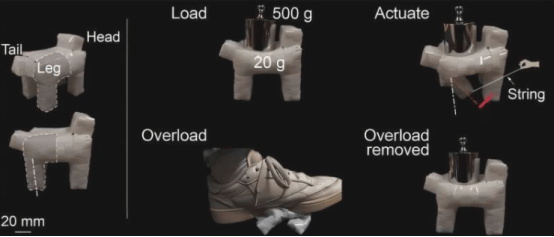
The research team was led by University of Michigan PhD student in Civil and Environmental Engineering Wayne Guo Wei Tu and Associate Professor Evgueni Filipov. During the research, Tu discovered that weaving techniques can be traced back to around 7500 BCE and explored their mechanical performance advantages. Filipov stated: "We know that weaving is an effective way to create 3D shapes from strips, but it should also possess potential mechanical properties."
The team conducted experiments using polyester film strips, with a width approximately the size of a little finger and a thickness equivalent to two sheets of copy paper. By transforming two-dimensional weaving into three-dimensional metamaterial structures, the researchers constructed four modules with different angular arrangements. Comparative experiments showed that continuous, un-woven polyester film structures exhibited permanent deformation after compression, while the woven structures could fully rebound even when compressed to 20% of their original height.
High-resolution 3D scanning revealed that the woven structures can distribute stress over a wider area, avoiding localized damage. In stiffness tests, the woven material exhibited 70% of the hardness of continuous structures, but its load-bearing capacity was significantly higher. For example, the L-shaped woven structure could vertically support a load 80 times its own weight, and the biomimetic woven robot could carry 25 times its own weight while maintaining mobility.
Tu noted: "Using basic angular modules, we can design complex spatial structures that combine both rigidity and elasticity." The team also proposed the concept of woven exoskeletons adapted to different body parts with varying stiffness, providing protection while maintaining movement flexibility.
Filipov added: "We plan to integrate electronically active materials into the woven structures to develop intelligent systems capable of sensing the environment and autonomously deforming." This research opens a new direction for lightweight, reusable engineering materials.