
Researchers at the University of Texas at Austin have proposed a new method to improve oil recovery. Modeling studies show it is highly effective, producing more oil, storing more carbon, and offering higher safety compared to traditional methods. This triple benefit comes from the university's leadership in alternative carbon carrier technology research.
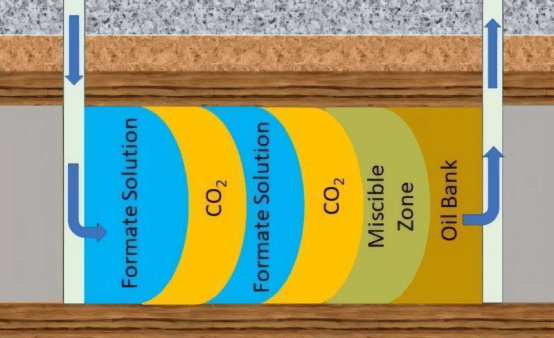
Alternative carbon carriers are compounds specifically designed to store large amounts of carbon molecules underground. When synthesized from carbon dioxide (CO₂), they help optimize the transportation, utilization, and storage of this greenhouse gas. In a study applying this technology to enhanced oil recovery scenarios, researchers from the University of Texas Jackson School of Geosciences and Cockrell School of Engineering found that the new carbon carrier method can recover 19.5% more oil and store 17.5% more carbon compared to traditional enhanced oil recovery methods.
The study's lead author, Abuzar Mirzaei-Paiaman, Research Assistant Professor at the Bureau of Economic Geology at the Jackson School, said the technology aims to maximize oil recovery while increasing the amount and safety of carbon storage. The research results were published in the journal Energy & Fuels.
For decades, oil and gas companies have used enhanced oil recovery (EOR) techniques to extract more oil from reservoirs. CO₂-based EOR technology uses carbon dioxide gas to drive out residual oil from rock pores and sequesters the CO₂ underground. Using carbon capture and storage technology, companies can use CO₂ emissions from burning hydrocarbons to extract more oil while reducing the net carbon footprint of petroleum.
However, co-author of the study, Professor Ryosuke Okuno of the Hildebrand Department of Petroleum and Geosystems Engineering at the Cockrell School, said that to maximize the amount of carbon emissions stored in reservoir space, it is better to use CO₂ as the starting point for synthesizing more effective carbon carriers. "We don't have to use CO₂ directly; we can find better ways, such as capturing CO₂ and converting it into formates, such as sodium formate or potassium formate."
Formates are carbon-based molecules that can be synthesized from CO₂ gas. Okuno said that under the same conditions, formates are easier to store in rock pores than an equivalent amount of CO₂. In addition, the water-based solution of formate compounds is more viscous than CO₂, helping to improve residual oil recovery and carbon sequestration efficiency in the formation.
The EOR method tested by the researchers involves alternating slugs of CO₂ gas and water-based formate solution to drive oil to the production wells. They compared this method with two traditional EOR methods: using only CO₂ gas and alternating CO₂ gas with water. All three methods were tested in a simulated reservoir created using real oilfield data from the Permian Basin in West Texas.
The results showed that compared with injecting CO₂ alone, the new carbon carrier method increased oil recovery by 19.5%, and compared with the combined injection of CO₂ and water, recovery increased by 1.9%. Compared with injecting CO₂ alone, the carbon carrier method increased carbon sequestration by 2.5%, and compared with the combined injection of CO₂ and water, carbon sequestration increased by 17.9%.
In addition to oil recovery and carbon sequestration, the researchers also analyzed the safety of carbon storage in the reservoir and found that the alternating injection of formate and CO₂ is the safest solution. It minimizes the escape of free-flowing CO₂ and creates a chemical buffering environment that better protects the integrity of reservoir rocks.
Overall, the study shows that using carbon carriers for EOR performs well. However, Okuno said that more work is needed to further refine and develop it for industrial use, such as the current insufficient production of formates from CO₂ to sustain EOR operations. Mirzaei-Paiaman studied potential carbon storage financial incentives for carbon carrier technology and believes that adjusting policies to maximize carbon storage benefits will help stimulate the carbon carrier market. He said, "As long as policies and regulations support a certain technology, companies will move in that direction."