
The Korean Institute of Ocean Science and Technology (KIOST) has developed an ultrasonic cleaning device that can effectively remove salt (NaCl) from sea sand. The related research and verification results have been published in Scientific Reports.
Sand is an indispensable material in the construction of important social infrastructure such as roads, bridges and ports. Due to restrictions or even unavailability of river sand collection, sea sand has gradually become an alternative. Desalination of sea sand is a key process for its application in construction projects. If salt is not properly removed, it will cause corrosion of steel bars in reinforced concrete, leading to premature deterioration and damage of concrete structures, compromising their structural integrity and safety. The Ministry of Land, Infrastructure and Transport recommends that the allowable salt content (salinity) of sea sand used as construction aggregate should be 0.04% or below.
Dr. Gil-Lim Yoon from the Marine Space Development and Energy Research Department of the Korean Institute of Ocean Science and Technology (KIOST) has developed a new ultrasonic desalination instrument that can more effectively remove salt from sea sand. Its main technical features include: cavitation-driven ultrasonic cleaning, strong particle removal ability after bubble rupture, enhanced penetration, and non-contact cleaning using ultrasonic energy. Even in narrow spaces, this technology can perform sea sand desalination accurately and quickly, significantly reducing water consumption and processing time.
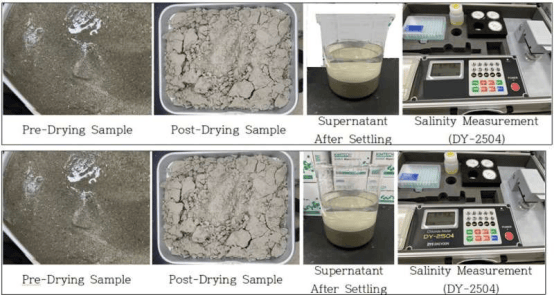
Currently, sea sand salt is removed by pouring large amounts of water onto the sand, requiring approximately four tons of water to treat one ton of sea sand. The ultrasonic method developed by KIOST first mixes sea sand with water at a ratio of 1:2, then treats the mixture with 300W or higher ultrasonic waves for three minutes, which can effectively reduce the salt concentration in sea sand to 0.04% or lower.
Hyi Seung Lee, President of KIOST, said: "This research is of great significance as it provides an innovative solution to the global shortage of river sand while ensuring structural integrity and economic feasibility. KIOST will continue to advance this technology to process large quantities of sea sand faster and more precisely."