
The University at Buffalo has made a major breakthrough in the field of robotic tactile perception. The new electronic textile (E-textile) it developed is expected to solve the problem of robots lacking good tactile sensation. The related research results were published in the journal Nature Communications on July 30.
For a long time, many robots have struggled to master basic human skills such as catching falling objects and controlling grip strength. Although scientists have equipped robots with tools such as cameras to enhance their perception, a simple and cost-effective solution has remained elusive.
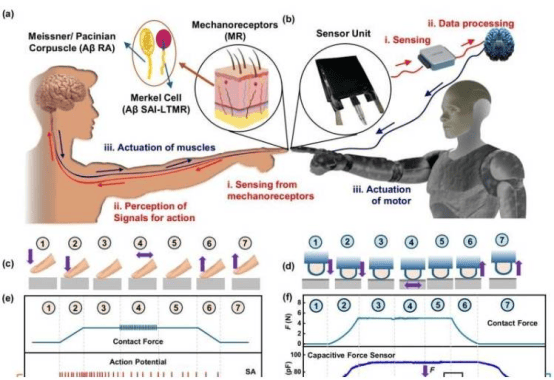
The new electronic textile developed by the University at Buffalo simulates the way human hand nerves perceive pressure and sliding when grasping objects. Dr. Jun Liu, Assistant Professor in the Department of Mechanical and Aerospace Engineering at the University at Buffalo's School of Engineering and Applied Sciences (also a core faculty member of the UB RENEW Institute and corresponding author of the study), said that this technology can be applied to manufacturing tasks such as product assembly and packaging, as well as various scenarios of human-robot collaboration, and can also help improve robotic surgical tools and prosthetics. The research team also includes Dr. Ehsan Esfahani, Associate Professor in the Department of Mechanical and Aerospace Engineering at the University at Buffalo, several University at Buffalo students, and a former PhD student from Professor Liu's team (now a postdoctoral scholar at the University of Chicago).
Waseem Gautham, PhD student in Professor Liu's research group and first author of the study, said that this sensor is similar to human skin — flexible and highly sensitive. It can not only perceive pressure but also detect subtle sliding and movement of objects. This breakthrough may change the way robots, prosthetics, and human-machine interaction systems interact with the surrounding world.
The researchers integrated the sensing system into a pair of 3D-printed robotic fingers, which were mounted on a flexible robotic gripper developed by Esfahani's team. Esfahani said that after sensor integration, the robotic gripper can detect sliding and dynamically adjust compliance and gripping force, enabling previously difficult handheld operation tasks. For example, when pulling a heavy copper object from the fingers, the gripper senses it and immediately tightens the grip force. He also stated that this sensor is a key component in making robotic hands closer to human hand functions. It utilizes the tribovoltaic effect, where friction generated by slight movement of an object produces direct current.
The researchers measured that the response time of this sensing system is comparable to that of humans, ranging from 0.76 milliseconds to 38 milliseconds depending on the experiment, while human tactile receptor reaction time is typically between 1 and 50 milliseconds. Professor Jun Liu said that the system's speed is astonishing and meets the biological benchmark set by human performance. The stronger or faster the sliding, the stronger the sensor response, which is beneficial for building control algorithms that enable robots to act precisely.
Currently, the research team plans to conduct additional tests on the sensing system, including integrating reinforcement learning artificial intelligence to further improve robot dexterity.