
Scientists from Nanyang Technological University (NTU Singapore) have achieved a major breakthrough by building the world's first automated production line for insect robots. This achievement marks a key step toward the large-scale application of insect-hybrid robots in complex environments, especially in disaster zone search and rescue operations. The related research was published in the journal Nature Communications.
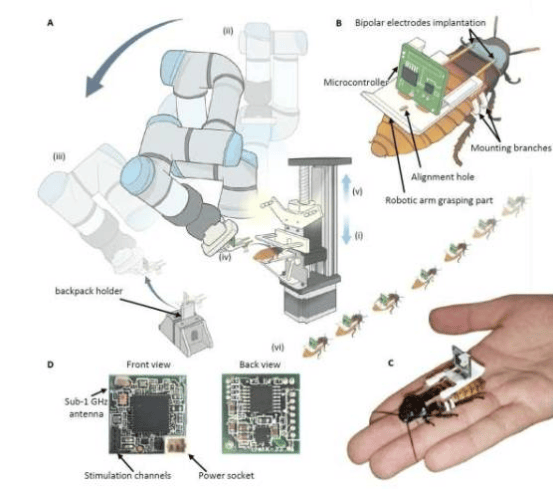
The automated system was led by Professor Hirotaka Sato from the School of Mechanical and Aerospace Engineering. The system can automatically attach miniature electronic backpacks onto the backs of Madagascar cockroaches, turning them into insect-hybrid robots. The installation process takes only 1 minute and 8 seconds, approximately 60 times faster than the traditional manual process that relies on trained operators, which usually takes more than an hour. When processing four insects, the entire assembly can be completed in 8 minutes, about 30 times faster than manual methods.
Professor Sato stated that manual preparation is time-consuming and heavily dependent on skilled operators. The automated process enables rapid and stable production of insect-hybrid robots, making large-scale preparation possible. This is critical for time-sensitive operations such as post-disaster search and rescue. Moreover, when the cockroaches are no longer needed or need extended rest, the miniature electronic backpacks can be safely removed without any adverse effects.
Unlike traditional robots, insect robots move naturally using all four limbs and are guided by mild electrical stimuli delivered through electrodes implanted via a lightweight circuit board on their backs. The artificial intelligence robotic assembly system uses computer vision and proprietary algorithms to precisely identify the optimal anatomical positions for implanting electrodes on the cockroach's back.
The researchers also designed a new generation of backpacks with voltage reduced by 25% compared to earlier versions. This maintains precise motion control while improving power efficiency, helping to extend operational time and reduce the risk of overstimulation. In laboratory tests, the hybrid insects were able to make sharp turns of more than 70 degrees on command and reduce their speed by 68%. Four robotic cockroaches covered more than 80% of a test area filled with obstacles in 10.5 minutes, demonstrating their ability to navigate narrow and cluttered spaces.
Although the assembly line is still in the prototype stage, insect robots equipped with the first-generation backpacks using manual installation have already been deployed in real-world operations. On March 30, 2025, a team of 10 robotic cockroaches accompanied the Singapore Civil Defence Force (SCDF) to Myanmar as part of the "Lion Heart" task force to respond to the devastating 7.7-magnitude earthquake that occurred on March 28, which claimed more than 3,000 lives. This was the first time insect robots were used in a humanitarian mission and the first field deployment of insect-hybrid robots. The on-site deployment demonstrated their potential in locating survivors in disaster-stricken areas where traditional robots struggle to enter and have limited operational time.
Professor Sato said that, based on field deployment experience, building infrastructure to support large-scale production and deployment is crucial. This assembly line is the first step and will pave the way for more reliable robotic applications, such as inspecting defects in large civil engineering structures. Professor Sato has received international recognition for his pioneering research on insect robots. His work was named one of "The 50 Best Inventions of the Year" by TIME magazine and one of the "10 Breakthrough Technologies" by MIT Technology Review.
Looking ahead, Professor Sato's team will continue to improve the assembly system and collaborate with local partners to further validate its effectiveness and readiness for industrial applications.