
An interdisciplinary research team at Graz University of Technology (TU Graz), together with corporate partners, has developed a building hook-and-loop fastening system for the ReCon project. The system enables elastic connections between different parts of a building and allows easy separation when necessary. It focuses on solving the connection problems of components with different service lives and avoids the difficulties of replacement caused by irreversible connections.
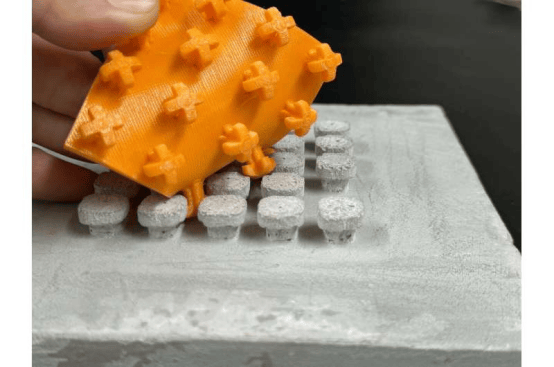
On one hand, the research involves bonding industrial hook-and-loop components to traditional concrete or wooden components. On the other hand, it explores the production of hook-and-loop components using construction raw materials such as concrete, wood, and paper-based materials. This system can correctly separate durable load-bearing structures from shorter-life installations, surfaces, and other elements.
In the ReCon project, TU Graz's Institute of Building Technology, Laboratory for Structural Engineering, and Institute of Bioproducts and Paper Technology (BPTI) collaborated with companies Axtesys and NET-Automation. Matthias Lang-Raudaschl stated that the core principle of ReCon is to dismantle buildings using clearly defined and separable interfaces. During renovation or reconstruction, only worn or components that need to meet new requirements are replaced, thereby extending the overall service life of the building and reducing construction waste and material consumption.
The hook-and-loop components made from construction raw materials work on the same principle as traditional hook-and-loop fasteners but are slightly larger in size. The mushroom heads or hooks are directly embedded in the components. The hook-and-loop elements are produced using 3D printing technology and firmly hooked onto the components. In tests conducted at TU Graz's Laboratory for Structural Engineering, the fastening system demonstrated good adhesive tensile strength comparable to industrial products.
The developed hook-and-loop fasteners are primarily intended for interior finishing, such as replacing non-load-bearing wooden or gypsum walls or components. The researchers hope to manufacture the hook-and-loop fasteners using injection molding or metal stamping processes to further improve the adhesive tensile strength.
In addition to the hook-and-loop system, researchers in the ReCon project have also developed a digital application concept to promote component reuse. The goal is to make component data available long-term to improve the circular economy. Two approaches are adopted: first, integrating RFID chips into the components so that stored data can be read on-site; second, studying methods to directly write or insert small amounts of data onto the components in the form of QR codes, making it convenient to use ordinary smartphones to assess the condition of components and potential pollutants, thereby improving the safety and simplifying the process of reuse.