
In Germany, despite high carbon emissions from cars, they remain the number one mode of transportation. To make environmentally friendly travel alternatives more attractive, researchers from the Fraunhofer Institute for Optronics, System Technologies and Image Exploitation (IOSB) are working with partners in the DAKIMO project to develop intelligent multimodal transport solutions and create an artificial intelligence system for multimodal route planning. The goal is to help people reduce dependence on private cars and achieve seamless, convenient, and reliable mobility.
Currently, there is a wide variety of eco-friendly travel options, including buses, trains, trams, electric scooters, and shared bicycles. Public transport has a far smaller environmental impact than private cars. However, cars remain the dominant mode of transport due to their constant availability and ease of trip planning. The key to making public transport an attractive alternative lies in the effortless combination of different transport modes, with switching between public transport, bicycles (especially shared bikes), and electric scooters being as convenient as grabbing car keys.
However, people are currently not fully utilizing the advantages of multimodal transport, mainly because planning routes from point A to point B using multiple modes of transport is too complicated. Existing route planning apps also fail to incorporate the connectivity between different transport modes into their recommendations.
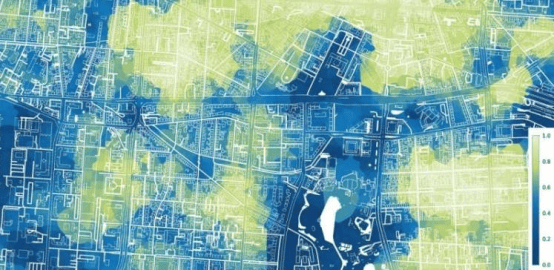
To solve this problem, the DAKIMO project was launched. Researchers at Fraunhofer IOSB in Karlsruhe have developed an AI-based system that can predict the availability of shared mobility vehicles, taking into account real-time factors such as traffic conditions. The system can calculate the probability of finding a rentable bicycle or electric scooter at a specific time and location. Project partner raumobil GmbH applies these predictions to multimodal route planning. The mobile app recommends travel routes from origin to destination based on predicted vehicle availability. Partners also plan to expand the regiomove app launched by the Karlsruhe Transport Authority (KVV) to make multimodal route suggestions a reality, allowing users to receive personalized transport recommendations based on current conditions and their specific needs and chosen routes.
Jens Ziehn, project leader at Fraunhofer IOSB, said that for more environmentally friendly multimodal transport, transportation needs to be simpler, more reliable, flexible, and easy to plan. The AI prediction function will recommend the best way to reach the destination according to specific circumstances, including different segments of the route, while displaying information about bookable vehicles (including shared cars) at the start and end points of the journey. When situations such as bus delays or no shared bikes available at the destination occur, artificial intelligence will intervene promptly. Reinhard Herzog, head of the Modeling and Network Systems Group at Fraunhofer IOSB, added that artificial intelligence uses small geographic units and short time intervals, based on historical data from public transport and shared bicycle locations, to calculate short- and long-term probabilities of availability and the expected number of shared cars, thereby enabling the prediction function.
In terms of transport data standards, this AI prediction function will be incorporated into the internationally recognized General Bikeshare Feed Specification (GBFS). GBFS is a real-time public data standard designed to provide transport information for consumer-facing applications and is currently undergoing a one-year evaluation. During the testing phase, the prediction function has been included in the standard extension draft. To enable widespread adoption of AI technology, it is crucial to add predicted probabilities for shared cars to the GBFS standard. Once implemented, the standard will not only show the current location of shared mobility vehicles but also provide AI-calculated predictions of future availability.
Based on GBFS data, route planning apps are expected to offer multimodal route options in the future. Project partner raumobil GmbH is committed to standardizing the prediction function, and the GBFS standard extension has been recognized by MobilityData, a non-profit organization focused on transport data standardization and exchange. The AI fusion server used to aggregate all data is now operational. It uses artificial intelligence to determine the availability of transport modes and calculate multimodal routes. The AI prediction function has also been integrated into the test version of the Karlsruhe regiomove app, which combines various mobility options in the Middle Upper Rhine region. The next step is to extend the prediction model to other regions in Baden-Württemberg.
A survey of more than 1,500 people conducted as part of the project showed positive public response, with nearly 90% of participants considering AI-based predictions for shared mobility very helpful or extremely useful. Approximately 20% of respondents said they occasionally leave their cars at home and use public transport because of the project. Ziehn stated that the research results confirm that AI-based approaches can effectively support the mobility transition and contribute to climate action.