
Facing the complex challenges confronting the global food system, Patrick Baur, a scholar from the Department of Fisheries, Animal and Veterinary Science at the University of Rhode Island, together with an interdisciplinary team, has published groundbreaking research in the journal Nature Food. The study proposes a new sustainable food system model inspired by mangrove ecosystems, offering innovative ideas for addressing climate change, resource scarcity, and ecological degradation.
Limitations of Traditional Models: Sustainability Is Not an Achievable Endpoint
Baur pointed out that current food system research mostly focuses on the "triple bottom line" of environment, economy, and society. However, sustainability is not a quantifiable endpoint but a dynamic process of balance. The research team likened it to a "horizon" — seemingly clear yet difficult to reach. Traditional linear or simple circular models can no longer reflect the complexity of reality.
Mangrove Inspiration: Interwoven Root Systems and Resilient Cycles
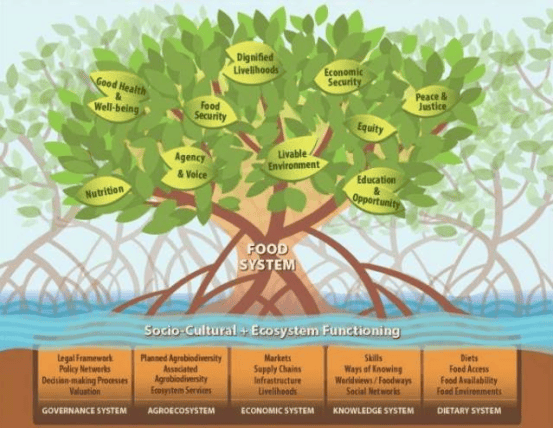
The research groundbreakingly reconstructs the food system as a "root network" similar to mangroves:
The trunk as the core of the cycle: The mangrove trunk symbolizes the closed-loop cycle of food production, distribution, and consumption. Its "bark" is determined by the nutrients provided by the roots, which decide the survival of the system.
The roots as the supporting network: Mangroves resist tidal impacts through interconnected root systems, metaphorically suggesting that the food system must rely on multi-dimensional “roots” such as culture, economy, and ecology for collaborative support.
Diversity as vitality: Mangroves adapt to harsh coastal environments through species diversity, inspiring the food system to enhance risk resistance through subsystem diversification.
Baur emphasized: "The resilience of mangroves is irreplaceable. They maintain ecosystem services amid tidal fluctuations, serving as a model for how food systems should respond to shocks such as droughts and hurricanes."
From Metaphor to Practice: Grassroots Innovation Drives Transformation
The study criticizes current agricultural models as resembling "invasive plants" (such as kudzu), where monoculture destroys ecosystem services. In contrast, the mangrove model advocates learning from grassroots social movements:
Food sovereignty: Empowering communities with control over resources and decision-making rights.
Regenerative agriculture: Enhancing ecological carrying capacity through soil health improvement.
Slow food movement: Rebuilding localized food chains and cultural identity.
Using the New England region as an example, Baur noted that although there are no mangroves, the ecosystem formed by marine eelgrass and terrestrial oak trees also demonstrates resilience. He called for agricultural systems to move away from the fragile "lawn grass" structure and shift toward diversified and autonomous sustainable models.
Resilience ≠ Passive Endurance; Adaptability = Active Evolution
The study further distinguishes between "resilience" and "adaptability":
Resilience is like a boxer recovering after taking heavy blows.
Adaptability is like anticipating an opponent's moves and dodging in advance.
Baur pointed out that the global food system needs both: buffering shocks through diversified design (resilience) and predicting risks using data and local knowledge (adaptability), thereby preventing local disasters from escalating into systemic crises.
Future Direction: Balancing Multi-dimensional Values
The research team emphasized that a sustainable food system must go beyond single economic indicators and simultaneously optimize "root" outcomes such as nutrition, health, equity, and ecology. Baur summarized: "The core of the mangrove model lies in 'symbiosis' — human livelihoods and ecosystems are not zero-sum games, but achieve dynamic balance through innovative design."
The model has already attracted international academic attention. Its interdisciplinary perspective provides a new dialogue framework for policymakers, agricultural practitioners, and environmental organizations, and may become a key theoretical pillar for the global food system transformation.