
Researchers at Queensland University of Technology have found a new way to incorporate copper ions into germanium telluride thermoelectric materials, significantly improving their ability to convert waste heat into electrical energy. The related research results were published in the journal Nature Communications.
Germanium telluride can be used in electronic devices to convert heat into electrical energy, helping to save energy and power small devices. In this study, in addition to first author Yongqi Chen, Professor Zhigang Chen, Dr. Meng Li, and Dr. Xiaodong Wang from Queensland University of Technology also participated.
Professor Zhigang Chen explained that copper doping is the process of adding a small amount of copper to a material to alter its properties (such as improving electrical conductivity). Although germanium telluride is known for its ability to convert thermal energy into electrical energy, due to the arrangement of atoms, the effect is often not ideal. The energy loss in most materials originates from the atomic arrangement structure.
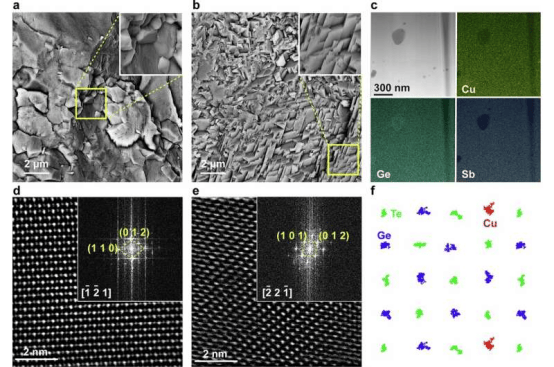
Yongqi Chen stated that the study adopted a targeted doping strategy, using copper ions to enhance the thermoelectric performance of the material, providing a new pathway for efficient energy conversion in materials. The atomic structure of germanium telluride has natural defects that affect its thermoelectric conversion performance. By attaching copper ions to specific points in the material's crystal structure, more energy can be generated than with similar materials previously.
Professor Chen said that previous attempts at copper doping in germanium telluride were "interstitial doping," which involves inserting copper ions between atoms in the lattice structure without replacing existing atoms. This study, however, employed an innovative solid-solution strategy that can precisely guide copper ions to replace existing atoms in the material.
In the field of thermoelectrics, researchers measure a material's ability to convert thermal energy into electrical energy or electrical energy into thermal energy by calculating the "figure of merit." Professor Chen said that the new material in this study has a figure of merit as high as 2.3, compared to 1.5 for previous versions, achieving an improvement of more than 50%.
Professor Chen also pointed out that this technology opens a path to identify defects in the atomic structure of materials, which can then be precisely improved using solid-solution treatment, thereby producing materials with better performance and fewer defects.