
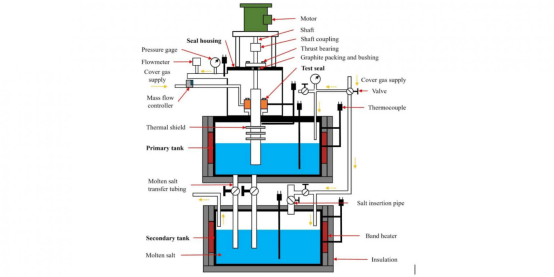
According to a report from the University of Michigan (UM), the Molten Salt Pump Shaft Seal Test Facility (SSTF) has successfully operated for 2,300 hours at the university's Thermal Hydraulics Laboratory. Globally, fewer than 10 facilities are capable of using more than 10 kilograms of material to successfully operate fluoride or chloride salts for over 100 hours. This experiment is of significant importance.
The project is led by Adam Burak, Assistant Research Scientist in the Department of Nuclear Engineering and Radiological Sciences (NERS) at the University of Michigan. NERS graduate student Shuai Che was responsible for the design, construction, and daily operation of the experiment. NERS Professor Xiaodong Sun provided support. The research focuses on large-scale thermal-hydraulic systems related to advanced reactors.
The experiment focused on studying the shaft seal performance of molten salt pumps under typical operating conditions. The working fluid used was 32 kilograms of FLiNaK, a common high-temperature salt mixture. During the experiment, the salt mixture was tested at three different operating temperatures — 500°C, 525°C, and 550°C — to evaluate the sealing performance under various thermal conditions. The experiment aimed to assess whether mechanical seals can operate reliably when exposed to molten salt vapor, while also tracking the SSTF's ability to measure gas consumption — that is, the amount of inert "cover gas" required to maintain an anhydrous and oxygen-free environment around the seal. In an operating reactor, the cover gas must be free of air and water vapor but may contain fission products that migrate into the gas space. A higher gas consumption rate means more off-gas needs to be treated, which could become a significant operational cost. The SSTF experiment helps quantify this critical parameter under long-term conditions, providing important data for future reactor designers.
The article states that the experiment achieved two major accomplishments. First, it is the first time in the United States that molten salt pump shaft seal performance data has been made publicly available. These data will help developers evaluate the most suitable sealing technologies for specific designs. Second, safe maintenance and troubleshooting of high-temperature systems were performed, and procedures for intervening while the system is at high temperature were developed. This skill is critical for the future operation of advanced reactors.