
A Korean research team has successfully developed a new type of stretchable quantum dot display material that demonstrates excellent color reproduction performance and mechanical stretchability. The research was led by Professor Jiwoong Yang from the Department of Energy Science and Engineering at the Korea Advanced Institute of Science and Technology (KAIST), in collaboration with Professor Moonkee Choi and Professor Jongnam Park from the Ulsan National Institute of Science and Technology (UNIST), and Professor Daehyeong Kim from Seoul National University.
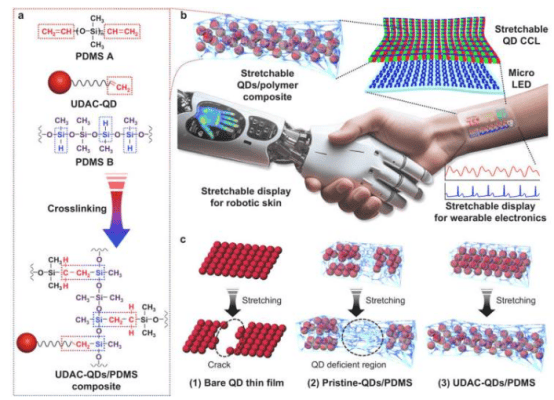
The research team innovatively connected quantum dot materials directly to stretchable polymers through chemical bonding, forming a high-performance color conversion layer. This technology solves the problems of particle aggregation and color bleeding that occur in traditional physical mixtures of quantum dots and polymers. The related research results have been published in the journal Advanced Materials.
The new color conversion layer achieves a high resolution of 313 PPI and maintains over 99% color conversion efficiency even when stretched beyond 50%. The researchers integrated this material with a micro-LED array to develop a full-color stretchable display with real-time pressure sensing capability. Professor Yang stated: "This study breaks through the limitations of existing quantum dot color conversion technology and holds application potential in fields such as wearable electronics and smart healthcare."
Experiments show that the display material is suitable for various scenarios, including robotic skin and wearable health monitoring sensors. Through molecular structure design, the research team constructed a special cross-linked network on the surface of eco-friendly quantum dots, enabling stable bonding with elastic polymers. This technical approach provides a new development path for next-generation stretchable displays.
The breakthrough in stretchable display technology brings new possibilities for the development of flexible electronic devices. The researchers noted that this material can adapt to various deformation requirements while maintaining high color fidelity, and is expected to promote the advancement of wearable device technology.