
Spin waves, as potential candidates for next-generation electronic devices, have drawn widespread attention to their quantized units — magnons. Magnons can transmit information in conductors with very low resistance, consuming far less energy than electron transport. Recently, the Low-Temperature Quantum Electronics Group at Technische Universität Braunschweig, in collaboration with an international team, successfully set a new record for the wavelength of excited propagating magnons. The research, led by Professor Oleksandr Dobrovolskiy, achieved highly efficient excitation of spin waves by introducing fluxons — a type of quasiparticle.
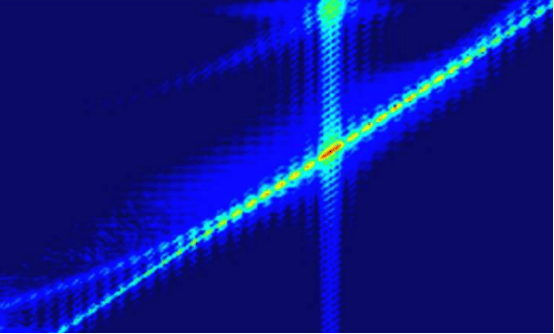
During the research, the team collaborated with institutions including Huazhong University of Science and Technology, Goethe University Frankfurt, University of Vienna, and University of Bordeaux. "Fluxons move in the form of superconducting magnetic flux quanta at speeds of up to 10 kilometers per second. We utilized this ultra-fast characteristic to excite spin waves in an adjacent magnetic material," explained Professor Dobrovolskiy. "This effect is similar to the bow wave created by a fast boat in water, but much faster, even producing a kind of sonic boom effect." The team also observed Shapiro steps in the superconductor's electrical response, confirming the synchronization between fluxon motion and spin waves, and revealing the coherent coupling mechanism between the two.
This achievement not only provides a new perspective for fundamental physics research but also paves the way for the development of spin-wave-based electronics. Professor Dobrovolskiy stated: "Our research is expected to drive future information processing systems toward smaller size, higher speed, and greater efficiency." With the modernization of facilities at the newly established Nano-Metrology Laboratory at Technische Universität Braunschweig, the Low-Temperature Quantum Electronics team now has the experimental conditions to extend hybrid fluxon-magnon systems down to the atomic scale, laying the foundation for further quantum excitation studies.