
A joint research team from the University of Göttingen in Germany, together with the University of Braunschweig, the University of Bremen, and the University of Fribourg in Switzerland, has for the first time directly observed the "Floquet effect" in graphene materials. The research results were published in the journal Nature Physics, providing experimental evidence for light-control technology in quantum materials.
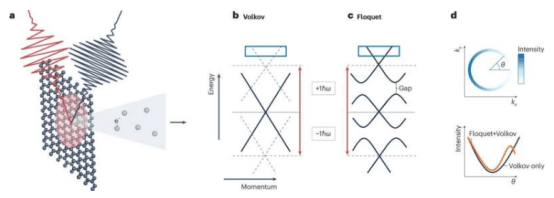
The study employed femtosecond momentum microscopy, using rapid light pulses to excite the sample and implementing delayed detection to successfully capture changes in the photoelectron emission spectrum in graphene. Dr. Marco Merboldt, a physicist at the University of Göttingen, stated: "The measurement results clearly confirm the existence of the Floquet effect in the graphene photoelectron emission process, indicating that light-pulse control methods are applicable to such quantum materials."
Floquet engineering is a technique that precisely regulates material properties through light pulses. This study resolves the long-standing debate on whether this method is suitable for metals and semimetals. Experiments show that laser pulses can be used to design quantum materials with specific electronic properties in extremely short timeframes, laying the foundation for the development of future electronic devices and sensor technologies.
Professor Marcel Reutzel from the University of Göttingen pointed out: "This research opens up a new pathway for light-controlled quantum materials and is expected to enable directed and controllable manipulation of electrons." The study also shows that this technology can be used to explore topological properties, which holds potential value for the development of quantum computers and the design of new sensors.
Graphene, as a single-atom-layer carbon material, possesses excellent electrical conductivity and stability, and is widely used in fields such as flexible electronics and high-efficiency batteries. The confirmation of the Floquet effect provides a new approach for light-controlled modulation of graphene devices.