
The European Southern Observatory's Paranal Observatory in Chile has captured an image of the Bat Nebula, located approximately 10,000 light-years from Earth, using the VLT Survey Telescope (VST). This VST image of the nebula covers an area of sky equivalent to four full moons and is situated between the southern constellations of Circinus and Norma. The gas and dust cloud structure forms a distinctive bat-like shape.
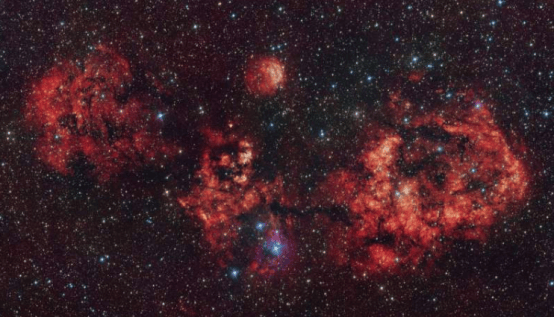
The Bat Nebula, as a star-forming region, glows red from hydrogen atoms excited by the energy of young stars. The colder, denser gas and dust bands within the nebula form the dark, skeletal fibrous structure of the bat, with some regions officially catalogued as RCW 94 and RCW 95. The VST telescope, owned by the Italian National Institute for Astrophysics (INAF), is equipped with the 268-megapixel OmegaCAM camera. The final image was created by combining multi-band observational data.
Observatory researchers combined visible-light and infrared data. The main image of the nebula was obtained through the VST Southern Galactic Plane and Bulge Hα Survey project, while dense regions of the nebula were supplemented with data from the VISTA Vía Láctea Variability Survey conducted by the Visible and Infrared Survey Telescope for Astronomy (VISTA). Both survey datasets are openly accessible to researchers worldwide.
Thanks to its large field-of-view observational capabilities, the VST telescope continues to record the structure of the Milky Way and the process of star formation. The newly released image of the Bat Nebula demonstrates the VST telescope's technical capabilities in wide-field astronomical imaging and provides new observational data for studying the environments where stars are born in the universe.