
A research team at the National Institute for Materials Science (NIMS) in Japan has successfully developed a magnetic tunnel junction (MTJ) using a high-entropy oxide, achieving enhanced perpendicular magnetic anisotropy, a higher tunneling magnetoresistance (TMR) ratio, and lower electrical resistance. The findings have been published in the journal Materials Today.
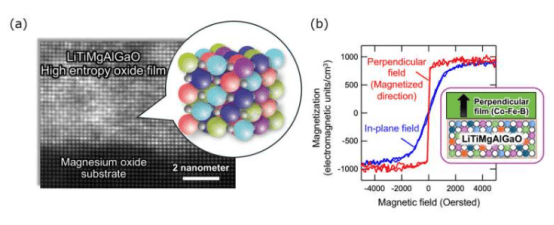
A magnetic tunnel junction consists of two ferromagnetic layers separated by an ultrathin insulating tunnel barrier layer, and its operation is based on the quantum tunneling effect of electrons. While the widely used magnesium oxide (MgO) barrier can achieve a relatively high TMR ratio, its large barrier height leads to higher device resistance. To address this limitation, the NIMS team innovatively developed a high-entropy oxide composed of lithium, titanium, magnesium, aluminum, and gallium (LiTiMgAlGaO), with atomic-level uniform mixing as the tunnel barrier material, effectively overcoming this technical bottleneck.
Experimental results show that MTJ devices using the new high-entropy oxide barrier exhibit significantly enhanced perpendicular magnetic anisotropy, with a TMR ratio exceeding 80%, while the barrier height is reduced to less than half that of MgO-based materials. These material properties not only significantly increase tunneling current but also reduce overall device resistance. This breakthrough provides a new materials solution for developing smaller, higher-capacity, and higher-performance hard disk drives (HDDs) and magnetoresistive random-access memory (MRAM).
The research team stated that the next step will focus on optimizing multi-element combinations and ratios to further develop tunnel barrier materials with lower resistance and higher TMR ratios. They also plan to introduce machine learning and other data-driven approaches to accelerate the discovery of new materials and advance the development of high-capacity, high-performance memory devices.