
In the salt flats of the Atacama Desert, the radii of magnesium and lithium ions are nearly identical, and their chemical behavior in aqueous solutions is highly similar. This "twin effect" has rendered over half of the world's salt lake lithium resources economically unviable for extraction to date. The University of Atacama, in collaboration with the University of Antofagasta and the University of Chile, is forging a "chemical sieve" to tackle this century-old challenge using ionic liquids and metal-organic frameworks (MOFs).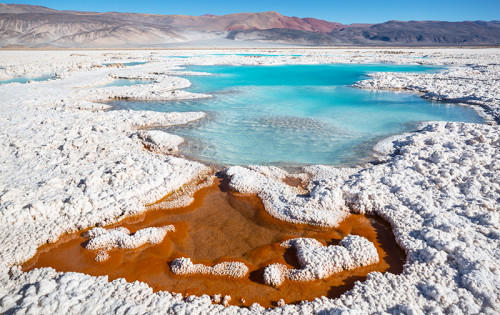
High Mg/Li Ratio: A "Global Challenge" for Lithium Mining
Global lithium resources are primarily found in salt lake brines, but not all salt lakes are suitable for traditional evaporation-precipitation processes. When the concentration ratio of magnesium ions to lithium ions (Mg/Li) in brine exceeds a certain threshold, magnesium ions compete with lithium ions for precipitation sites, leading to a sharp decline in lithium recovery rates and skyrocketing production costs.
Dr. Jonathan Castillo, a scholar from the Department of Metallurgy at the University of Atacama in Chile, points out that many salt lakes contain extremely high concentrations of interfering ions like magnesium and calcium, making these brines chemically and engineering-wise very complex and currently uneconomical to exploit.
This technical bottleneck means that a vast amount of global salt lake lithium resources is "locked" underground, unable to enter the supply chain. With the explosive growth in demand for lithium from electric vehicles and energy storage markets, developing efficient lithium extraction technology for high Mg/Li ratio salt lakes has become one of the most urgent research priorities for the global mining industry.
Building a "Chemical Sieving" System with Ionic Liquids and MOFs
On April 20, 2026, the University of Atacama officially announced a three-year Anillo collaborative research project. Led by the University of Atacama, with participation from the University of Antofagasta and the University of Chile, the project's core goal is to develop an advanced system for extracting lithium from salt lakes based on ionic liquids and metal-organic frameworks (MOFs) within three years.
Ionic Liquids: "Molecular Claws" Tailored for Lithium Ions
Ionic liquids are liquid salts composed entirely of ions, remaining liquid at room temperature. They possess extremely low vapor pressure, excellent thermal stability, and high structural designability. The research team leverages the tunable structure of ionic liquids to design extractant molecules at the molecular level with a high affinity for lithium ions.
The core chemical logic of this technology lies in the fact that the cations or anions of ionic liquids can be designed as "molecular claws" with specific coordinating groups, preferentially "grabbing" lithium ions in a complex ionic environment while repelling interfering ions like magnesium and calcium. Experimental data shows that some high-performance ionic liquid extraction systems have achieved lithium/magnesium separation factors exceeding 4600, offering a molecular-level solution for lithium extraction from high Mg/Li ratio salt lakes.
MOF Materials: Nanoscale "Ion Channels"
Metal-organic frameworks (MOFs) are porous crystalline materials formed by the self-assembly of metal ions/clusters and organic ligands. They boast an extremely high specific surface area and precisely tunable pore structures. The research team functionalized ionic liquids and incorporated them into MOF materials to create ionic liquid@MOF composite functional materials.
The three-dimensional pore system of MOFs synergizes with the chemical selectivity of ionic liquids: the porous structure of MOFs provides high-flux ion transport channels, while the embedded ionic liquids impart chemical selectivity for lithium ions to the inner walls of the channels. This dual mechanism of "physical sieving plus chemical recognition" allows lithium ions to pass through efficiently while effectively blocking interfering ions like magnesium and calcium.
From Copper to Lithium Mining: Technology Cross-Over and Tri-University Synergy
Dr. Castillo revealed that this research is not starting from scratch. The team has long been engaged in research on solvent extraction technology for copper ores, accumulating extensive experience in metal separation. "Translating" the knowledge and tools from copper extraction to the field of lithium mining is a key logical starting point for this technological innovation.
In the project implementation, the three top Chilean universities have distinct roles, forming a complete R&D chain:
University of Atacama: Responsible for the molecular design, synthesis, and screening of ionic liquid extractants, having already developed a series of high-performance ionic liquid solvents
University of Antofagasta: Responsible for the engineering design of process circuits, transforming laboratory-scale extractants into industrially scalable process schemes
University of Chile: Responsible for the engineering verification of parameters, establishing reliable technical benchmarks for the technology's transition from laboratory to industrial application
Technical Implications: A Paradigm Shift from "Evaporative Concentration" to "Chemical Capture"
Traditional salt lake lithium extraction relies on 12-24 months of natural evaporative concentration, followed by chemical precipitation to separate lithium. This process is limited by brine composition, climatic conditions, and land resources, and is nearly ineffective for high Mg/Li ratio salt lakes.
The ionic liquid-MOF composite technology represents a completely different technical pathway: moving from "passive evaporation" to "active capture". The extractant molecules actively recognize and capture lithium ions at the molecular scale, independent of the initial brine concentration and environmental conditions. If this technology is successfully industrialized, it could bring a large number of currently classified "difficult-to-use" salt lake lithium resources into the extractable category.
Unlocking Global "Dormant" Lithium Resources
1. The Key to Unlocking High Mg/Li Ratio Salt Lakes
A vast number of global salt lakes are considered "marginal resources" due to their high Mg/Li ratio. If the ionic liquid-MOF selective extraction technology achieves the expected separation efficiency, these salt lakes could transform from "geological resources" into "economically recoverable reserves," holding strategic significance for diversifying the global lithium supply chain.
2. A "Green Transition" for Lithium Mining
Compared to traditional evaporation-precipitation processes, solvent extraction technology significantly reduces energy and water consumption. Dr. Castillo emphasizes that the technology focuses not only on lithium extraction but also on the comprehensive recovery of multiple elements from salt lakes. In the future, Chile's salt lakes could upgrade from "single-element lithium mines" to "comprehensive utilization bases for co-developing multiple resources like lithium, potassium, boron, and magnesium."
3. Three-Year Roadmap: From Lab to Pilot Verification
According to the project plan, the technical roadmap for the next three years includes:
Year One: Complete screening of ionic liquid extractants and optimization of MOF composite materials
Year Two: Complete process circuit design and continuous operation verification at laboratory scale at the University of Antofagasta
Year Three: Complete engineering parameter validation at the University of Chile, laying the foundation for industrial pilot trials
The "Second Revolution" in Chilean Lithium Technology
Chile possesses the world's largest recoverable lithium resources but has long relied on the single resource of the Atacama Salt Flat and relatively traditional extraction methods. This ionic liquid-MOF lithium extraction technology, jointly advanced by three top Chilean universities, is expected to bring a second technological revolution to Chile's lithium mining industry, following the "evaporation method."
For the global mining industry, the significance of this technology extends far beyond a new extractant—it validates a complete technological pathway from "molecular design" to "engineering scale-up." When the molecules of ionic liquids can be precisely designed like "Lego bricks," and the pores of MOFs can be precisely tuned like "sieve meshes," lithium extraction is entering an era of "materials design" from an era of "process optimization."