
A research team led by Professor Doo-Yeol Yoo at Yonsei University in South Korea has published a study in the journal Cement and Concrete Research, developing a completely cement-free, ultra-high ductility strain-hardening slag composite (SHSC) for the first time, using powdered calcium hydroxide (CH) as an alkali activator.
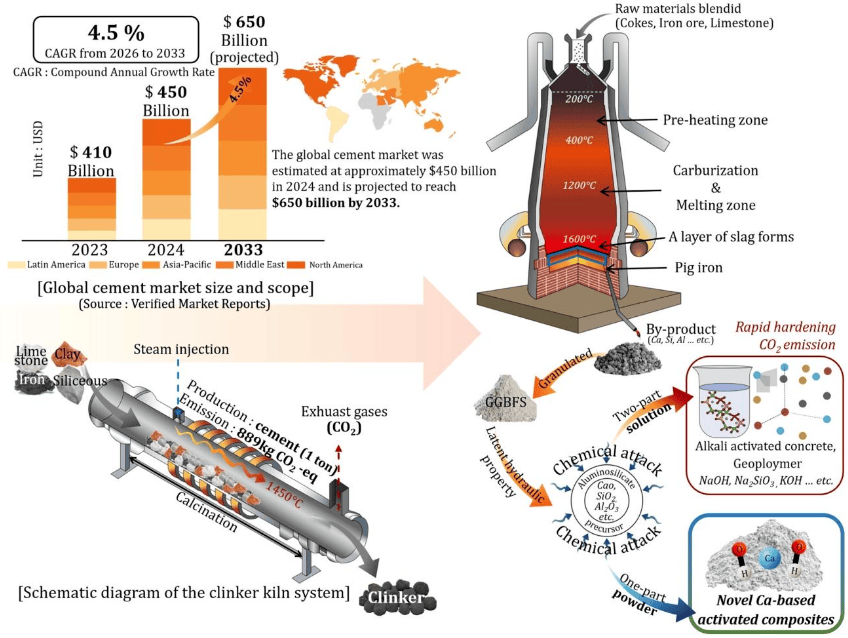
Addressing the issues of traditional strain-hardening cementitious composites (SHCC/ECC) being highly dependent on Portland cement (with carbon emissions over 2.2 times that of ordinary concrete), as well as the drawbacks of mainstream sodium-based alkali-activated systems (such as efflorescence caused by free sodium ion migration and construction difficulties associated with liquid strong alkalis), the study systematically investigated the regulation mechanisms of CH content (2.5%–15% by mass of slag) on slag hydration kinetics, gel polymerization degree, interfacial properties, and multi-crack cracking behavior. The study used a fixed water-to-binder ratio of 0.18, replaced 20% of the slag with silica fume by mass, and incorporated 2% by volume of polyethylene (PE) fibers to achieve strain-hardening characteristics.
TG/DTG, pH, and ICP-OES test results indicated that increasing the CH content significantly enhanced the alkalinity of the pore solution in the system, reaching a maximum pH of 12.32, which promoted the formation of C-S-H gel and hydration products like hydrotalcite. 29Si NMR results confirmed that as the CH content increased from 2.5% to 15%, the mean chain length (MCL) of silica tetrahedra in the C-S-H gel increased from 3.14 to 6.29, demonstrating a significant increase in the degree of polymerization of the silicate network. SEM analysis showed that increasing the CH content densified the fiber-matrix interfacial transition zone, substantially enhancing the fiber pullout resistance.
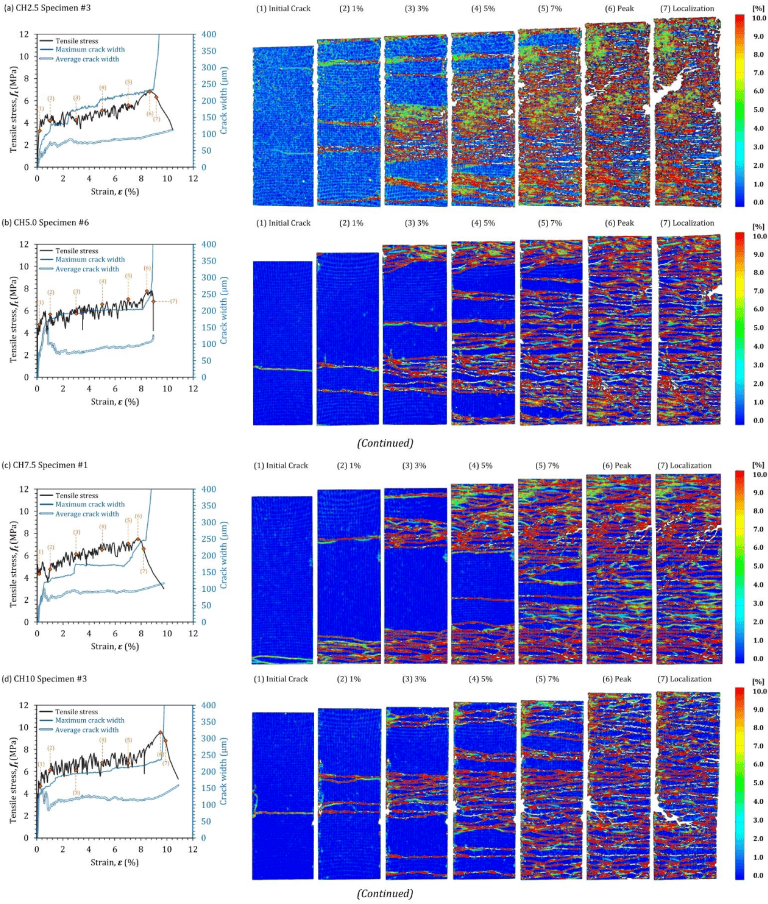
Macro-mechanical property tests demonstrated that compressive strength steadily increased with higher CH content. The 15% CH group achieved a 28-day compressive strength of 61.9 MPa, an 18.8% increase over the 2.5% CH group. All groups exhibited tensile strains exceeding 8%. The 15% CH group achieved optimal comprehensive performance with a tensile strength of 10.05 MPa, a tensile strain of 9.19%, and a strain energy density of 664.9 kJ/m³, with its tensile ductility meeting the standard requirements for HRB400 grade construction steel. Quantitative analysis using Digital Image Correlation (DIC) technology revealed that the average crack width at peak strain was only 89–127 μm.
Life Cycle Assessment (LCA) results showed that the optimal 15% CH group had a CO₂ emission of 409.05 kg/m³, which is 70.2% lower than traditional cement-based SHCC and 38.01% lower than sodium-based alkali-activated strain-hardening systems. Its embodied energy was 8.50 GJ/m³, a 23.9% reduction compared to cement-based systems.